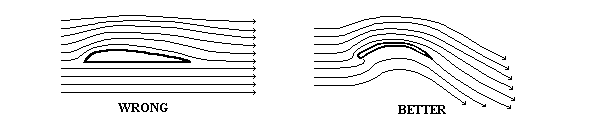
THE TWO COMPETING EXPLANATIONS FOUND IN K-6
BOOKS:
Here is the typical "Airfoil shape" or "Popular" explanation of
airfoil lift which commonly appears in childrens' science books:
As air approaches a wing, it is divided into two parts, the part which
flows above the wing, and the part which flows below. In order to create
a lifting force, the upper surface of the wing must be longer and more
curved than the lower surface. Because the air flowing above and below
the wing must recombine at the trailing edge of the wing, and because the
path along the upper surface is longer, the air on the upper surface must
flow faster than the air below if both parts are to reach the trailing
edge at the same time. The "Bernoulli Principle" says that the total
energy contained in each part of the air is constant, and when air gains
kinetic energy (speed) it must lose potential energy (pressure,) and so
high-speed air has a lower pressure than low-speed air. Therefore,
because the air flows faster on the top of the wing than below, the
pressure above
is lower than the pressure below the wing, and the wing driven upwards by
the higher pressure below. In modern wings the low pressure above the
wing creates most of the lifting force, so it isn't far from wrong to say
that the wing is essentially 'sucked' upwards. (Note however that
"suction" doesn't exist, because air molecules can only push upon a
surface, and they never can pull.)
MY NOTES:
(1996)
Uh oh, wind tunnel photographs of lift-generating wings reveal a
serious problem with the above description! They show that the
divided parcels do not recombine at the trailing edge. Whenever
an airfoil is adjusted to give lift, then the parcels of air above
the wing move far faster than those below, and the lower parcels lag
far behind. After the wing has passed by, the parcels remain forever divided. This has nothing to do with the wing's path lengths. This even applies to thin flat wings such as a "flying
barn door." The wind
tunnel experiments show that the "wing-shape" argument regarding
difference in path-length is simply wrong.
Also, real-world aircraft demonstrate another fallacy. In order to
create lift, must a wing have greater path length on the
upper surface than on the lower? No. Thin cambered (curved) wings
such as those on hang gliders and on rubberband-powered balsa
gliders, have equal path length above and below, yet they generate
lift. Still the air does flow faster above these wings than below.
However, since there is no difference in path length, we cannot
refer to path length to explain the difference in air speed above
and below the thin wing. The typical "airfoil shape" explanation
cannot tell us why a paper airplane can fly, because it does not
tell us why the air above the paper wing moves faster.
It is also a fallacy that in order to create lift, a wing *must* be
more curved on top. In fact, wings which are designed for high
speed and aerobatics are symmetrical streamlined shapes, with equal
curvature above and below. Some exotic airfoil shapes are even
flat on top and more curved on the bottom! (NASA's "supercritical"
wing designs, for example.)
If the typical "popular" or "airfoil-shape" explanation is
correct, then how can symmetrical wings and thin cambered wings
work at all? How can rubberband balsa gliders work? Those who
support the "path length" explanation will sometimes suggest that
some other method must be used to explain these particular wings.
But if so, why then do so many books put forth only the above
"popular" explanation as the single explanation of aerodynamic
lift? Why do they avoid detailing or even mentioning any other
important explanations of lifting force?
The cloth aircraft of old had single-layer wings having
identical path length above and below. If the "Wing-shape" or
"popular" explanation is correct and path-length is very
important, how can the Wrights' flyer have worked at all?
Conversely, we do find that thin airfoils such as the Wrights'
have faster flow on the upper surface than the lower surface.
Since the path lengths are identical, how can we explain this?
The above "path length" viewpoint would predict that the
addition of a lump to the top of a wing should always increase the
lift (since it increases the upper surface path length.) In fact,
the addition of a lump does not increase lift. This suggests that
there is a problem with the "airfoil shape" explanation of lift.
Forces on sailboat sails are explained using the typical
"pathlength/wingshape" explanation above. But sailboat sails are
thin cloth membranes with identical path-lengths on either side.
Why should air on either side of a sail have different velocities
if the path length is the same?
Children have experience with rubberband-powered balsa wood
aircraft having wings composed of a single flat layer of very
thin wood. Paper airplanes usually have flat thin wings. These
aircraft cannot fly? How can the "path length" version explain
their successful operation?
Regardless of the angle of attack, if a wing does not deflect
air downwards, it creates no lift at all. To say otherwise would
go against the law of Conservation of Momentum. Yet those who
believe in the "airfoil-shape" explanation commonly state that
wings operate only by pressure, and Newton's laws are unimportant.
This is a direct violation of basic physics principles.
Bernoulli's equation incorporates basic physics, and anyone who
depart from Newton must automatically depart from Bernoulli as
well. Besides buoyancy and helium balloons, the only way to remain
aloft is to take some matter and accelerate it downwards. The
downward force applied to the matter is equal to the upward force
applied by the matter against the craft. Rockets work like this,
as do ship propellers, jet engines, helicopters, ...and wings!
Some people argue that the "path length" explanation must be
right, since some wings generate lift even at zero angle of
attack. However, Attack-angle is determined geometrically, by
drawing a line between the tip of the leading and trailing edge.
This geometrically-determined attack angle can be misleading:
Small bumps on the leading edge of a blunt-nosed wing have a large
effect on where the line is drawn. These bumps strongly affect
the determination of "attack angle, yet these bumps may have
little if any effect on the lifting forces being generated. Also,
once the "zero AOA" geometry has convinced us to tilt the trailing
edge downwards,
inertial effects will cause the airfoils to deflect air
downwards from its trailing edge more than it deflects air
upwards at its leading edge. The downward tilt of the trailing
edge generates significant lift even when the wing as a whole is
lift even angle of attack. This type of wing may APPEAR
at zero attack angle. The inertia of air causes the air
to flow straight from the trailing edge of the airfoil. Because
of inertia, the trailing edge of a cambered airfoil itself behaves
as a tilted plane, and therefore the airfoil effectively has a
positive angle which causes air to be deflected. Other cambered
wings are similar; they still have a positive "effective" attack
angle even when their geometrical attack angle is zero. The
trailing edge, not the airfoil itself, determines lift.
Some people argue that flat wings, symmetrical aerobatic wings,
Supercritical wings, and thin cloth wings do not employ the
Bernoulli Effect, and these wings must instead be explained by
Newton and attack angle. But as mentioned above, if jet fighters
and the Wright Flyer use Attack Angle rather than Bernoulli
Effect, why do the books teach only Bernoulli Effect? At the very
least, these books are ignoring an entire class of aircraft by
never mentioning Attack Angle. However, even these thin wings and
symmetrical wings exhibit the full-blown Bernoulli principle!
There is a large difference in speed between the upper and lower air
streams along flat wings. If a flat sheet of plywood is tilted
into the air stream, the air flows faster above the sheet than
below, the divided parcels never rejoin, and lift is generated by
the pressure difference. But the
flat sheet also deflects the air, and just as much lift is
generated by deflection of air. In fact, 100% of aerodynamic lift
can be explained by pressure forces and the Bernoulli principle.
And 100% of lift can
be explained by F=mA and Newton's third law. They are two
different ways
of explaining a single event. However, any appeals to differences
in path length are simply wrong, and any book which uses that
explanation is acting to spread science misconceptions.
An alternate explanation of lift: "ATTACK ANGLE"
As air flows over a wing, the flow adheres to the surfaces of the wing.
This is called flow-attachment, also the "Coanda effect." Because the
wing is tilted, the air is deflected downwards as it moves over the wing's
surfaces. Air which flows below the wing is pushed downwards by the wing
surface, and because the wing pushes down on the air, the air must push
upwards on the wing, creating a lifting force. Air which flows over the
upper surface of the wing is adhering to the surface also. The wing
"pulls downwards" on the air as it flows over the tilted wing and off the
trailing edge, and so the air pulls upwards on the wing, creating more
lifting force. (Actually the air follows the wing because of reduced
pressure, the "pull" is not really an attraction.) The lifting force is
created by Newton's Third Law and by conservation of momentum, as the
flowing air which has mass is deflected downward as the wing moves
forward. Because of Coanda Effect, the upper surface of the wing actually
deflects more air than does the lower surface.
My notes on "attack angle":
If you understand the "attack angle" explanation, then the causes
of other aircraft phenomena such as wingtip vortex will suddenly
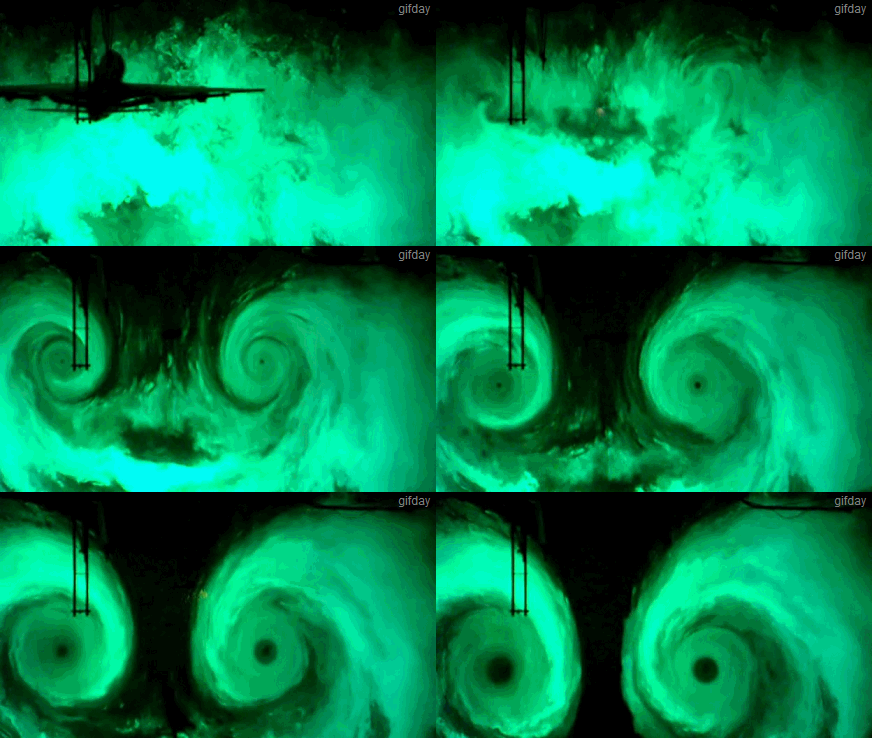
become clear. The air at the trailing edge of the wing is
streaming downwards into the surrounding still air. The edge
of this mass of air curls up as the air moves downwards, creating
the "wingtip vortex." A similar effect can be seen when a drop
of dye falls into clear water: the edge of the mass of dye curls
up as the dye forces itself downwards into the water, resulting
in a ring vortex which moves downwards.
There is one major error associated with the "attack angle"
explanation. This is the idea that only the LOWER surface of
the wing can generate a lifting force. Some people imagine that
air bounces off the bottom of the tilted wing, and they come to
the mistaken belief that this is the main source of the lifting
force. Even Newton himself apparantly made this mistake, and so
overestimated the necessary size of man-lifting craft. In reality,
air is deflected by both the upper and the lower surfaces of the
wing, with the major part being deflected by the upper surface.
Because a large, heavy aircraft must deflect an enormous amount of
air downwards, people standing under a low-flying aircraft are,
after a short delay, subjected to a huge downblast of air. They
are essentially feeling a portion of the pressure which supports
the plane. Imagine standing below a helicopter that hovers a
few tens of yards above the ground. Enormous downwash? Now
imagine that helicopter flying along at 150mph, or imagine the
blades detaching and flying away perpendicular to travel, like
wings, and you end up with the usual physics of fixed-wing
aircraft. All aircraft wings are essentially sucking in air from
all directions and flinging it downwards. This fact gets lost
when the aircraft moves horizontally much faster than its downwash
moves vertically. Some people even come to believe that wings
don't deflect air at all, or leave air moving downwards after the
aircraft has passed by.
The downwash can be useful: when a cropduster flies low over a
field, the spray is injected into the airflow coming from the
wings. Rather than trailing straight back behind the craft, the
spray is sent downwards by the downwash from the wings. Also,
during takeoff the downwash interacts with the ground and
causes lift to greatly increase. Pilots often use this effect to
gain a large airspeed just after takeoff. Because of downwash
"ground effect," their engine needs to do much less work in
keeping their aircraft aloft, therefore the extra power available
can be used to speed up the plane.
To create adequate lift at extremely low speeds, an airfoil
must be operated at a large angle of attack, and this leads to
airflow detachment from wing's the upper surface (stall.) To
prevent this, the airfoil must be carefully shaped. A good low-
speed airfoil is much more curved on the top, since lift can be
created only if the wing surface carefully deflects air downwards
by adhesion. Thus one origin of the misconception involving "more
curved upper surface." The surface must be curved to prevent
stall, not to create lift but to avoid losing lift. The situation
with the lower surface is different, since the lower surface can
deflect the air by collision. Even so, it makes sense to have the
lower surface be somewhat concave, so that the air is slowly
deflected as it proceeds along, and so the upwards pressure is
distributed uniformly over the lower surface.
Why does flowing air adhere to the upper surface of the wing? This
is called flow-attachment, also "the Coanda effect." Apparently
Dr. Bernoulli has a better PR department than Dr. Coanda, (grin!),
since everyone has heard of Bernoulli, while Coanda is rarely
mentioned in textbooks.
The only correct part of the "wingshape/pathlength" explanation of
lift is the description of the Bernoulli effect itself. But the
"Bernoulli Effect" can also be interpreted thus: because the
wing is tilted, it creates a pocket of reduced pressure behind its
upper surface. Air must rush into this pocket. And at the tilted
lower surface, air collides with the surface and creates a region
of increased pressure. Any air which approaches the high pressure
region is slowed down. Therefore, the pressure is the cause of
the air velocity, not vice-versa as in the "airfoil-shape"
explanation above. Also, it is wrong to imagine that the low
pressure above the wing is caused by the "Bernoulli effect" while
the high pressure below the wings is not. Both pressure
variations have similar origin, but opposite values.
The "airfoil shape" explanation could be very useful in
calculating the lifting force of an airfoil. Knowing the fluid
velocity at all points on the airfoil surface, the pressure may be
calculated via Bernoulli's equation at all points, and if the
pressure at each point is vector summed, the total lifting force
upon the wing will be obtained. The trick then is knowing how to
obtain the fluid velocities. Appeals to differences in pathlength
do not work, so other methods (circulation and Kutta condition)
must be used.
| |