Though our calendars are arbitrary dating systems, the sense of ending, of beginning, of closure, completion of cycle, possibly of apocalypse, invites our projections, stokes our fantasies, and occasions large images. What do these thoughts, fantasies, visions tell us about history, about ourselves, about how our psyche works? Jung said every psychology is a subjective confession; thus, our millennialist visions reveal the invisible workings of the unconscious and what directs our lives whether we know it or not. What can reading the millennialist visions tell us about ourselves?
The quality of our relationships with others can never rise above the quality of our relationship to ourselves. As the level of our personal development can only approximate the achievement of consciousness, so we are inevitably drawn to contract relationships through unconscious processes, projections, and hidden transactions. This workshop will focus on three arenas of relationships: parent-child, which helps form our personality in profound ways, interpersonal, which is often troubled by the unconsicous processes of each party, and self-divine, where the journey of the individual soul takes its place in the larger quest for meaning. In these three modalities of relationship our lives play their course, with the only consistent element being the presence of self. Accordingly, we will focus on the questions which we need to ask of ourselves in order to enhance the relationship to self, which may then enhance the relationship to the Other.
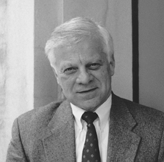
James Hollis, Ph.D., is a Zurich-trained Jungian analyst in practice in Houston, Texas where he is also Director of the C.G. Jung Educational Center. He is a training analyst for the Inter-Regional Society of Jungian Analysts. Additionally, he is the author of numerous books; his most recent work is The Eden Project: In Search of the Magical Other, a depth psychological approach to relationships.