Portage Bay’s long history of floating communities, combined with the contemporary, two‑week Opening Day “pop‑up” floating village, helped Seattle Yacht Club (SYC) and Queen City Yacht Club (QCYC) negotiate meaningful constraints on how the SR 520 temporary construction bridge and related work could proceed.
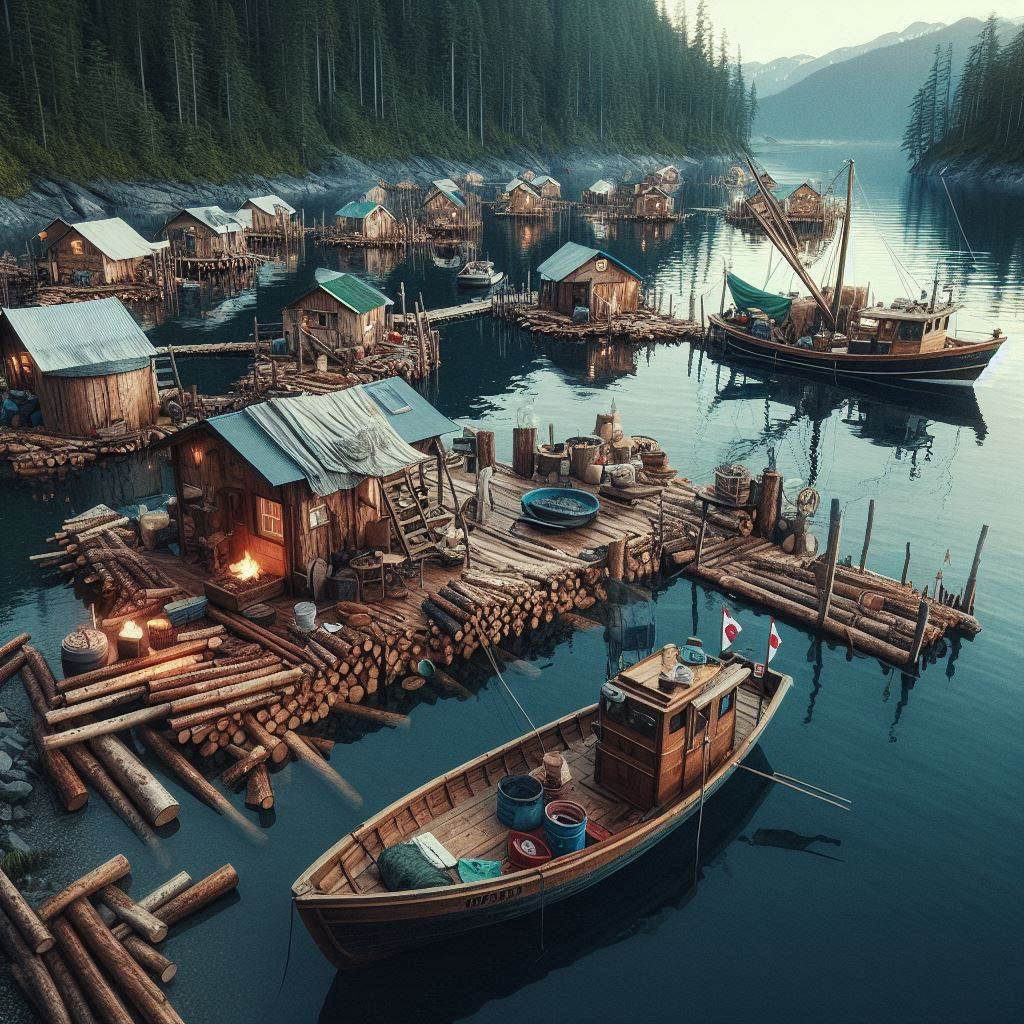
The earliest floating homes around Lake Union, Portage Bay, Union Bay, Salmon Bay, and the Duwamish were not romantic retreats but plain shelters for loggers, fishermen, mill workers, and laborers who needed to live next to their jobs. These structures were cheap, often self‑built, and seen as temporary: they could be moved as logging fronts shifted, fisheries opened and closed, or construction projects began and ended. Houseboats clustered where rail spurs, mills, and shipyards needed hands, and their mobility let working families follow seasonal and episodic work without the expense of buying or renting land‑based housing. Well into the early twentieth century, city elites and reformers dismissed these communities as unsightly “slum boats,” underscoring how strongly they were associated with rough labor and impermanence rather than with leisure or luxury.
Historic and cultural context of Portage Bay
For more than a century, Portage Bay has been a working and living waterway, first for industrial houseboats tied to logging, fishing, and mill work, and later for organized floating‑home communities and yacht clubs. That continuity made it easy to argue that living, gathering, and staging boats on the water are not incidental uses, but the core historic character of the bay.
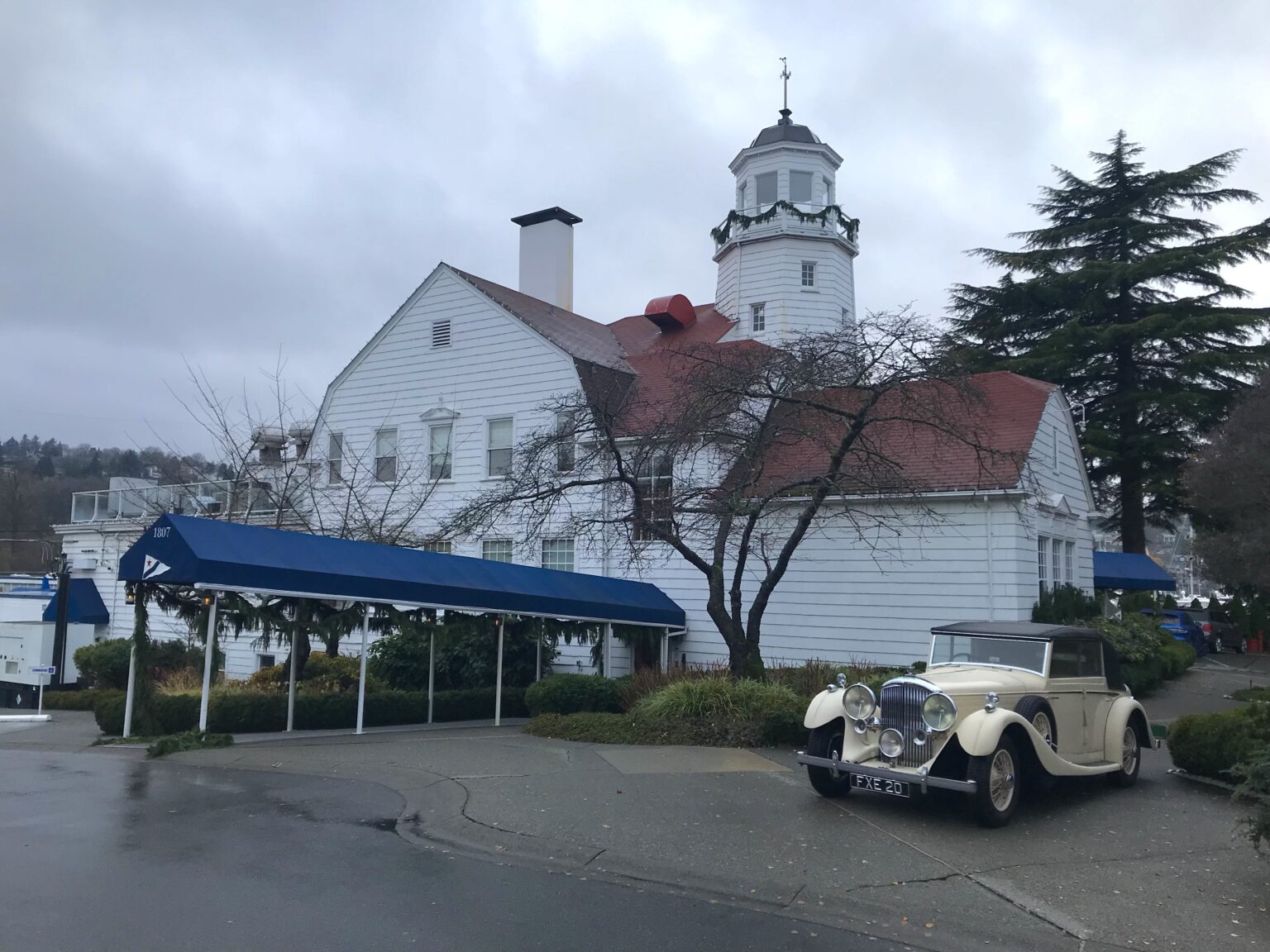
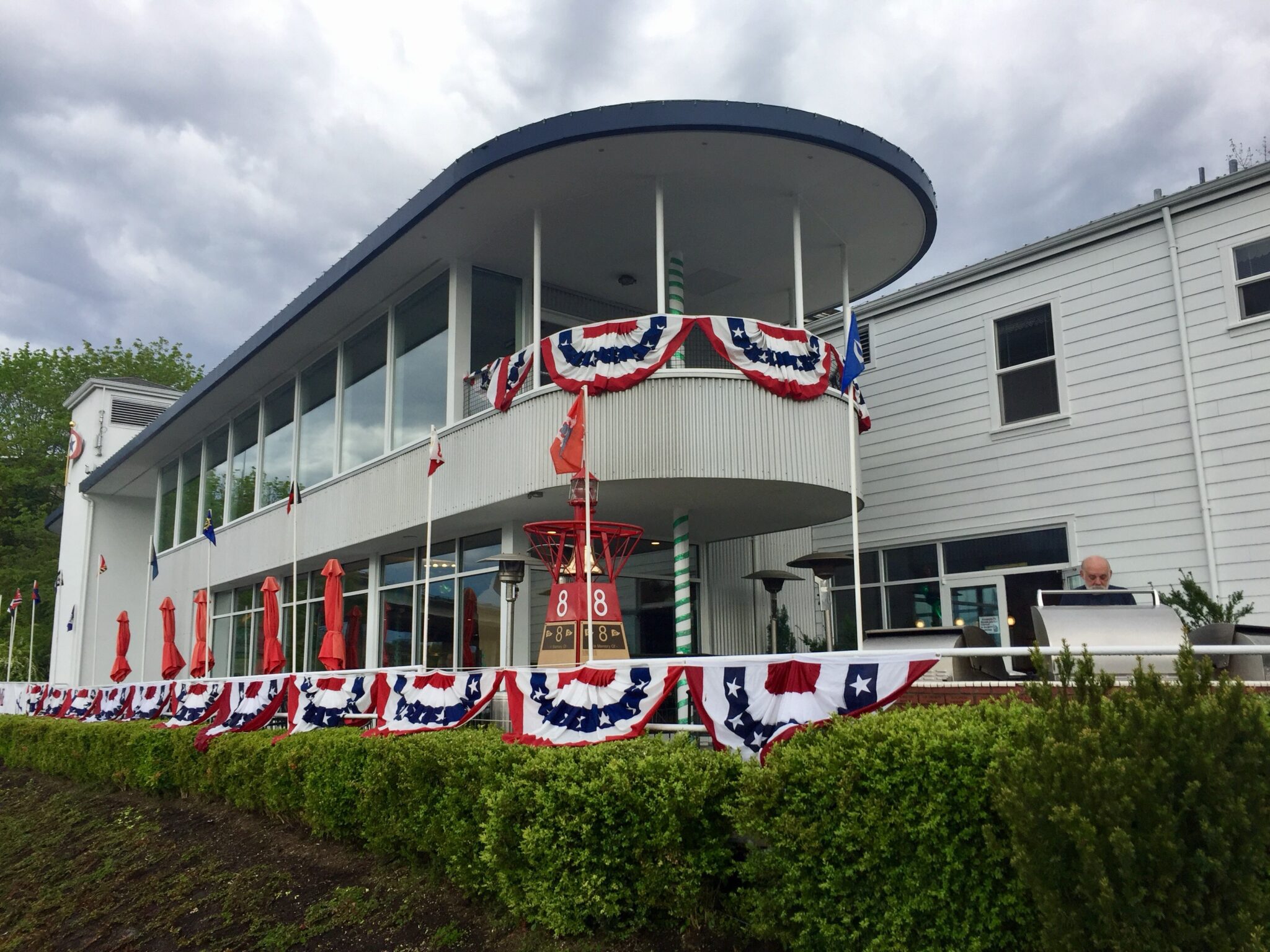
Seattle Yacht Club seized on the new hydrologic reality as soon as the Montlake Cut linked Lake Union and Lake Washington, relocating its main clubhouse to a grand Colonial Revival building on Portage Bay in 1920. The new site, selected in the wake of the canal’s completion, turned Portage Bay into a ceremonial gateway between salt water and the inland lake, and the club’s docks became staging areas for events, regattas, and the now‑iconic Opening Day boat parade. Within this setting, a floating home used as dignitary quarters at SYC functioned as a kind of prestige houseboat: still a floating dwelling tied to work—in this case, the work of hosting visiting officials and guests—but also a symbol that the once‑humble houseboat form had been appropriated into the rituals of elite yachting.
SYC’s 1920 Portage Bay clubhouse was listed on the National Register of Historic Places in 2006 specifically for its architectural significance and its role in Seattle’s social and cultural life, with Opening Day singled out as a defining civic event. This listing formalized the idea that the clubhouse and the adjacent water—used to stage, decorate, and parade boats—constitute a single historic setting.
The Montlake isthmus between Lake Union and Union Bay was once a continuous strip of low, marshy ground that Indigenous people crossed by canoe portage along well‑used trails. When the Lake Washington Ship Canal and Montlake Cut were completed in 1916, engineers dredged a channel, lowered Lake Washington, and altered the shorelines of Portage Bay and Union Bay in ways that left previously dry or marshy land permanently under water. Before the canal, the city and state had already begun to treat the shallow lake margins as real estate; by 1907 Seattle platted and sold “Lake Union Shore Lands,” including submerged parcels, to upland owners so they could legally build docks and moor floating structures. In effect, industrial infrastructure and city finance schemes literally created the legal and physical space in which floating communities on Portage Bay and Lake Union could exist.
The Opening Day floating community as leverage
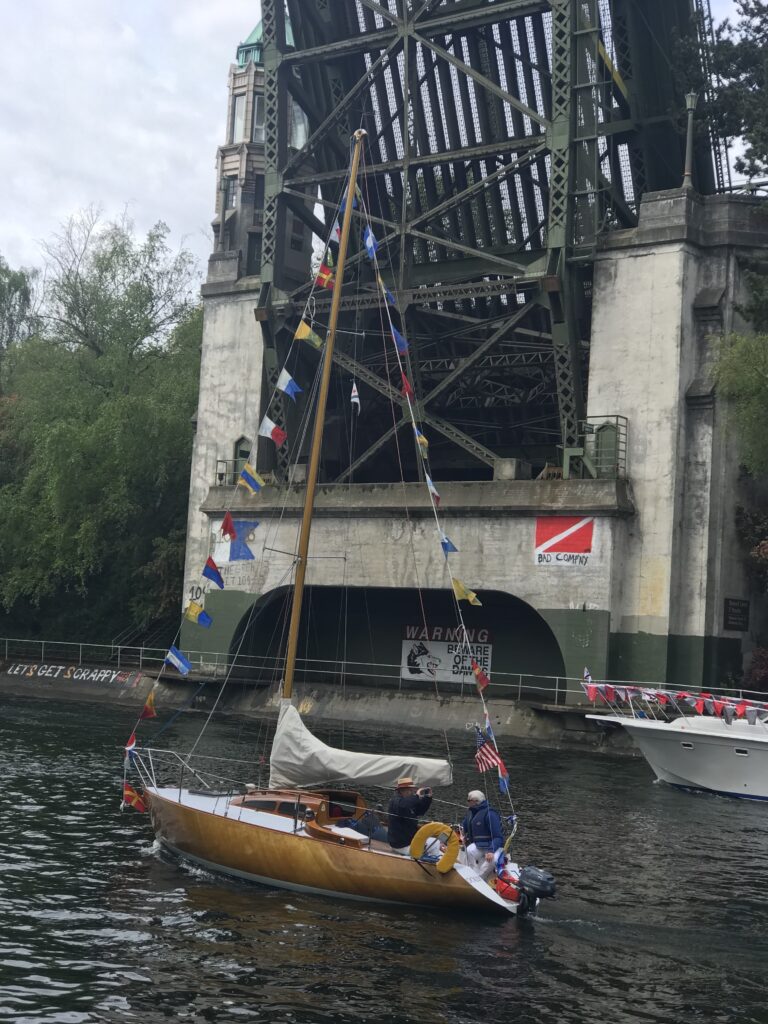
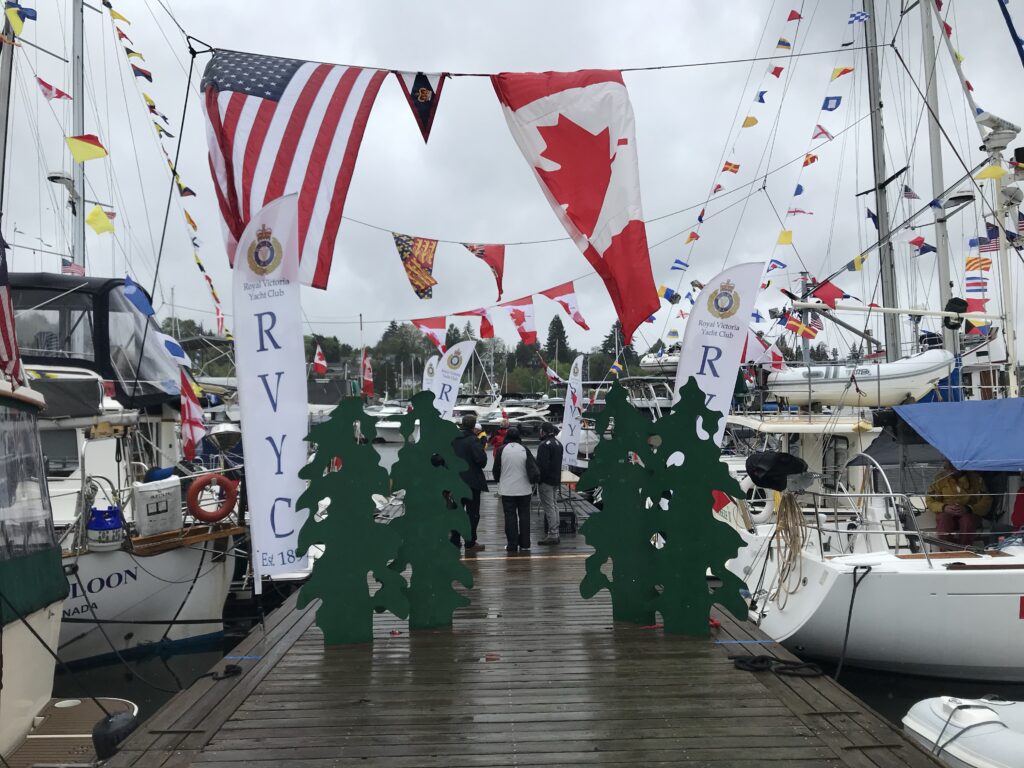
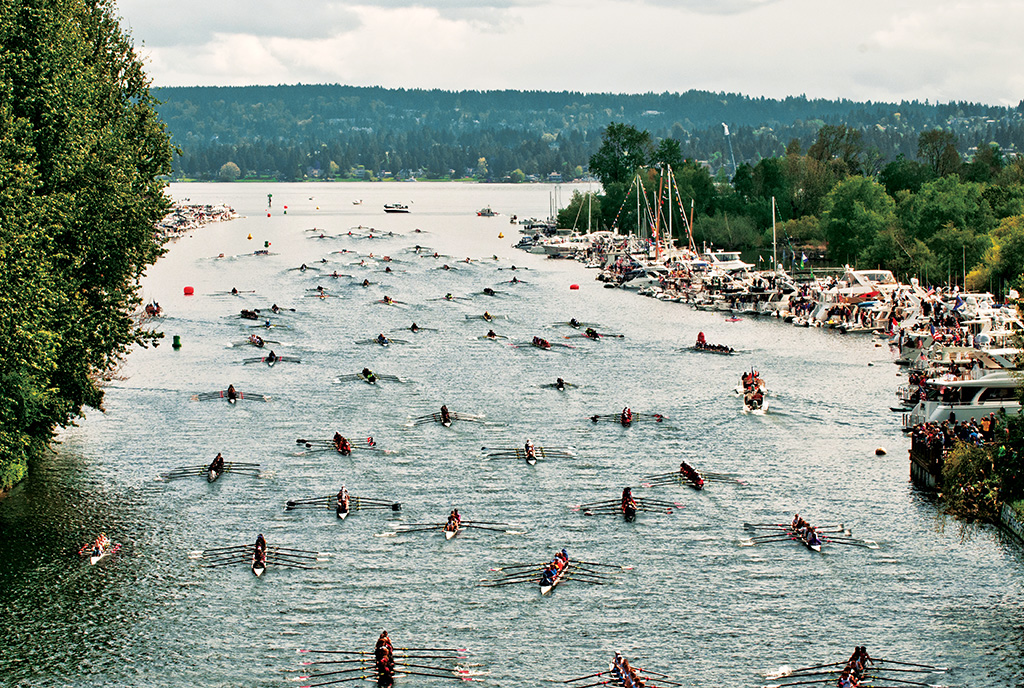
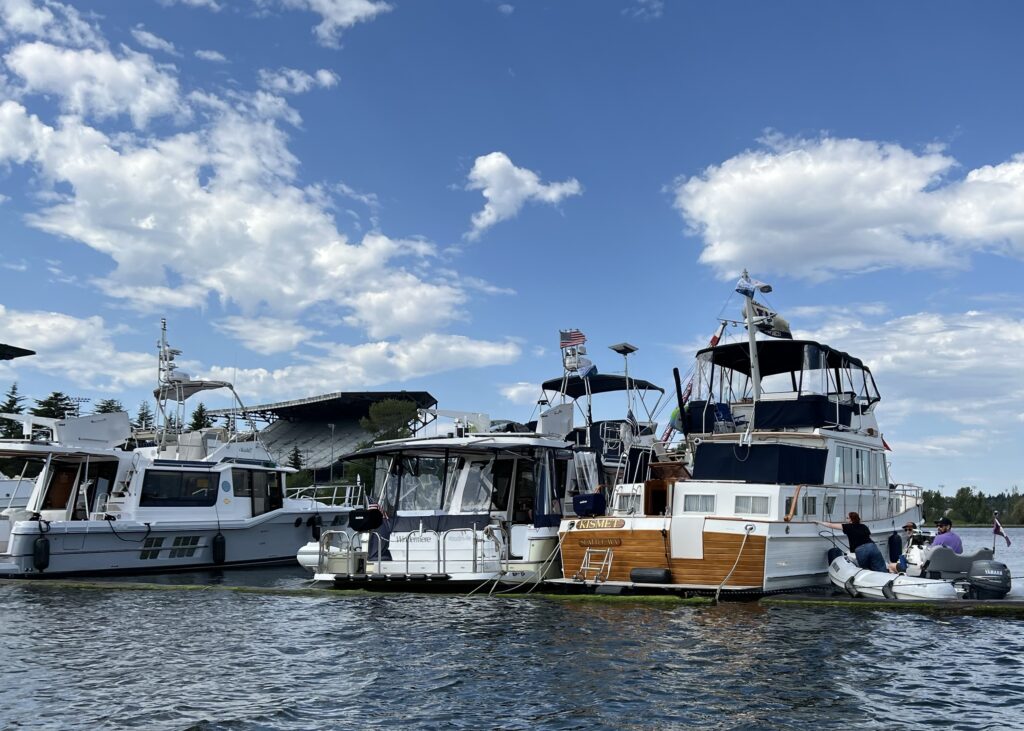
Each year, SYC and QCYC support the creation of a temporary, roughly two‑week floating community: Dock Zero and surrounding moorage fill with boats that effectively “move in” for Opening Day preparation, socializing, and the parade itself.
This pattern closely echoes Portage Bay’s earlier floating work camps—temporary but essential waterborne communities organized around a specific, time‑bound purpose.
Dock Zero of Seattle’s Opening Day can be read as a contemporary descendant of those mobile, work‑linked floating homes. Just as early houseboats were moved to follow logging camps, fishing grounds, or construction work, Dock Zero is towed or positioned at Seattle Yacht Club specifically for the “work” of Opening Day: the gathering, decorating, and organizing of vessels for the parade. For the duration of its stay at SYC, Dock Zero becomes a temporary neighborhood, a floating village where Salish Sea boaters and residents converge to share tools, stories, meals, and celebration in a concentrated burst of communal labor and festivity. When the event ends, Dock Zero, like the old working houseboats, moves on; the community disbands or scatters back to its home ports, leaving only the memory of a purpose‑built, waterborne homestead that existed because of a specific task in a specific place
Because this seasonal community is central to the recognized historic and cultural role of SYC (and, in practice, to QCYC’s operations as well), both clubs could legitimately argue that noisy, space‑consuming construction—especially a temporary bridge encroaching on navigable water south of Dock Zero—threatened not just convenience, but the integrity of a long‑standing civic tradition.
The SYC dignitary houseboat, moored at Portage Bay, extended the older pattern of purpose‑located floating structures, yet in a more ceremonial register. While early houseboats followed log drives, fish runs, and shipyard contracts, this vessel followed the social calendar, concentrating visiting yacht racers, club officials, and other honored guests at the very edge of the Opening Day action. Its presence underscored that, even within a prestigious yacht club, floating habitation could still be understood as temporary infrastructure: a structure brought in to perform a kind of labor—hosting, entertaining, accommodating—and then eventually removed when needs, regulations, or tastes changed. As Portage Bay real estate became more valuable and regulatory attention to floating residences increased, the dignitary houseboat’s removal mirrored the broader story of working and ad‑hoc houseboats being displaced, upgraded, or formalized into today’s regulated floating home docks.
How SYC used historic status
SYC’s national‑register status gave it formal standing in environmental and cultural‑resource review. The club could assert that:
Opening Day activities on the water are a character‑defining feature of the historic property.
Any construction that blocks staging areas, restricts navigation, or creates intolerable noise and vibration during the Opening Day window risks an “adverse effect” on a listed historic resource.
My favorite place in England: the path to Bathampton, along the Kennet and Avon Canal. The old town in Bath is well worth visiting for the Georgian architecture, Jane Austen vibe, and afternoon teas (50 shades of Earl Grey!), but this tree-lined walk leading away from the city, through colorful canal boats and historic buildings, is truly something special. We love walking around England – and always seem to end up at a pub. On one walk we encountered a floating community of canal boats. They had gathered to swap items and sell crafts. See Bath England
The result was not a total halt to construction, but a suite of commitments affecting timing and methods. Agencies agreed to:
Coordinate schedules so especially disruptive in‑water work and major tows would not occur during Opening Day or its immediate run‑up.
Configure the temporary construction bridge and work barges so Dock Zero and its approaches, while constrained, remained usable for staging and parade traffic.
In short, historic status translated into calendar and space protections that preserved the two‑week floating community’s ability to form and function.
How QCYC gained protections without a listing
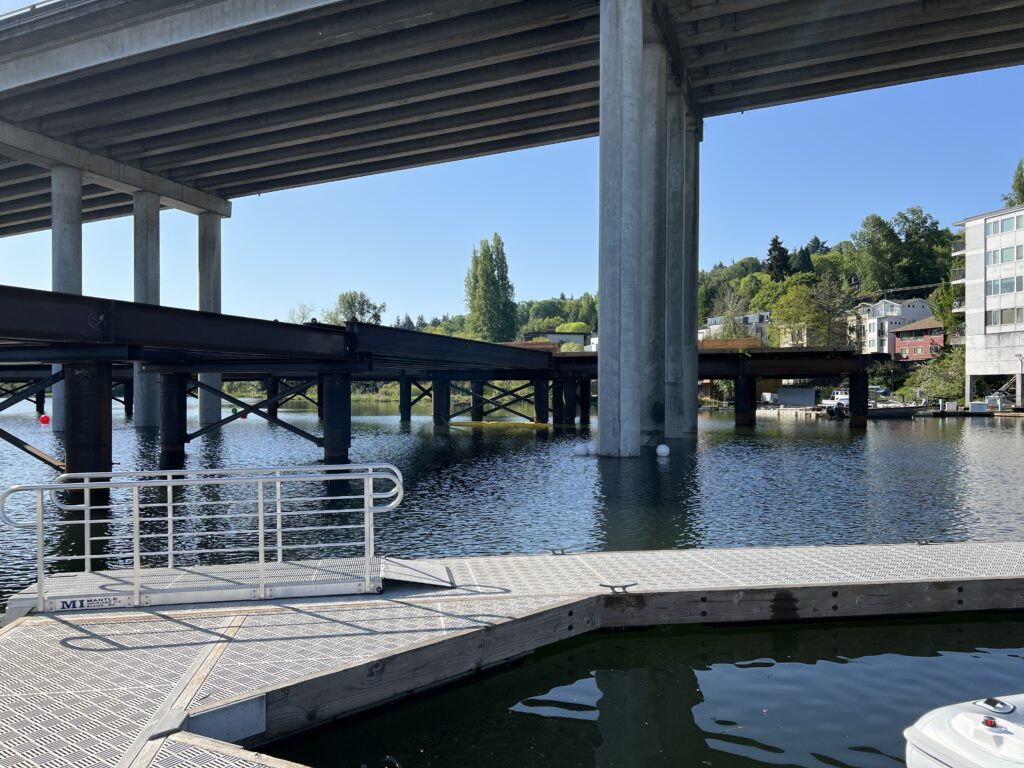
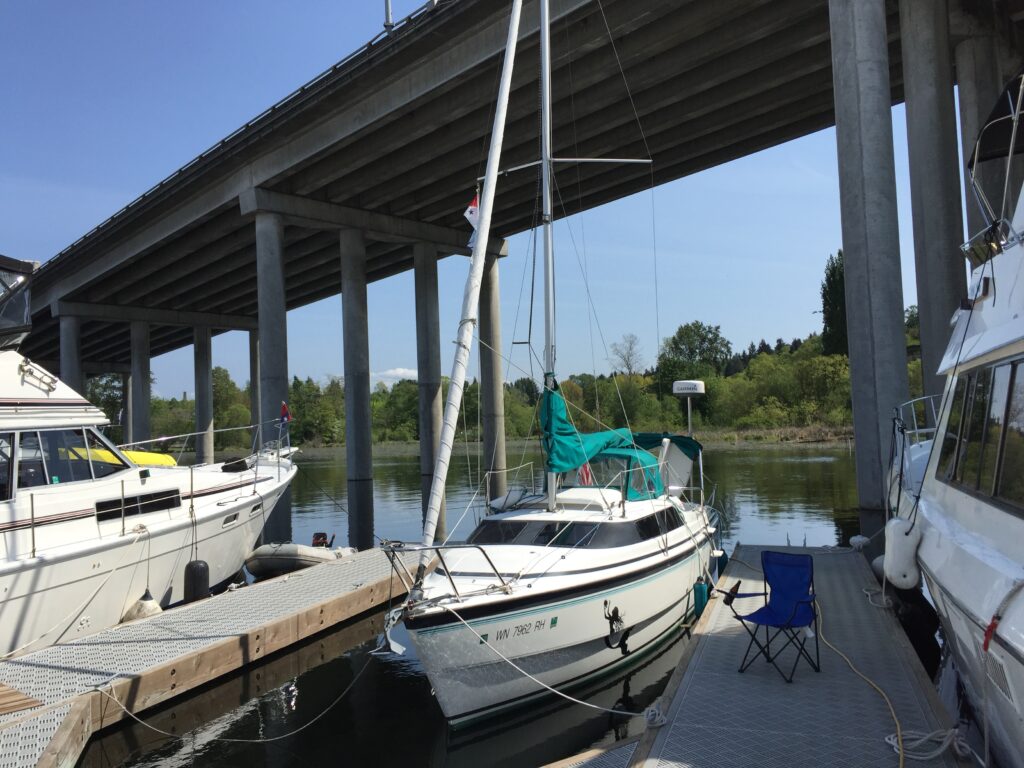
QCYC does not appear to have a formal historic designation, and that might suggest less leverage. But the two‑club Opening Day ecosystem and QCYC’s position directly under the new Portage Bay span made it a “frontline neighbor” whose operations could not be ignored.
As floating communities took root, yacht clubs arrived on Portage Bay and Lake Union with their own, more formal claims to the newly submerged ground. Queen City Yacht Club, whose current facility lies on Portage Bay, benefits from the fact that the land under its docks had been dry before the lake was lowered; the club holds title to that now‑submerged property and later even purchased additional underwater lots to support expanded docks and covered moorage. This unusual ownership pattern, rooted in pre‑canal shorelines, means that what appears today as underwater marina space is legally an extension of an older, land‑based holding. Elsewhere around Seattle’s harbor areas, submerged lands between the “inner harbor line” and “outer harbor line” are held by the state and leased to upland owners, but Portage Bay yacht clubs sit at a historical hinge where private and public claims overlap on ground that was only flooded into existence by canal engineering.
Through the environmental and construction‑management process, QCYC secured:
Guaranteed continuous access to the club by land and water.
Relocation or replacement for slips temporarily taken for construction easements, with only minimal long‑term loss.
Noise, vibration, and marine‑traffic mitigation (controls on pile‑driving hours, muffling, no‑wake practices, and structural monitoring of docks).
SYC’s formal historic status effectively raised the stakes for disruption in the entire Portage Bay yacht‑club zone, and QCYC benefitted from that context: if Opening Day and the floating community must be preserved as a historic and civic asset, both clubs’ moorage, approaches, and operational patterns need protection.
The combined effect on the temporary bridge
Together, the deep historical ties to floating communities and the modern, two‑week Opening Day floating “village” gave SYC and QCYC a clear narrative: Portage Bay is not just open water under a highway; it is an annually reconstituted, water‑based neighborhood with recognized civic and historic value.
That narrative yielded concrete leverage over the temporary construction bridge and associated SR 520 work:
Agencies were compelled to treat the Opening Day window as a special protection period.
The design and placement of temporary bridges and work platforms had to preserve at least a functional corridor for Dock Zero and parade staging.
Both clubs obtained formal commitments on access, moorage protection, and impact mitigation, limiting how aggressively and when the noisiest, most disruptive construction could occur.
Queen City Yacht Club’s control of its submerged land highlights a parallel evolution from improvised to institutional waterfront use. Where early working houseboats tied up along whatever pilings or booms were available, QCYC’s moorages sit atop titled underwater parcels that were deliberately acquired, financed through member bond issues, and expanded with significant capital investment. The transition from makeshift houseboat rows to organized yacht club basins, backed by clear claims to submerged land, marks a shift in who gets to define the purpose of floating structures on Portage Bay and what kinds of communities they can host.
Log Boom of Dock Zero
The term “log boom” comes from the timber era, when floating logs were corralled in the water by cables, pilings, and anchoring hardware so they could be controlled and moved through Puget Sound’s industrial waterways. Those logs were real logs — buoyant timber used for flotation and storage, not decorative pieces — and the basic idea of the boom was to keep them together and under control. In Seattle’s event setting, that same floating-log idea was repurposed into a spectator platform with a distinctly maritime feel.
Windermere Cup Opening Day parade boats swarming toward Lake Washington. Windermere Cup (Seattle)
Crew racing is the origin story of 50 years of the event boom. Windermere Cup materials describe the log boom as the place where spectators tie up to watch the races, and the whole setup is explicitly part of Opening Day on the Montlake Cut. That means the boom functions as an extension of the event space — almost like additional dock room for overflow guests — with boats marshaled along it and movement managed as part of the regatta day flow.
Historically, log booms in the Seattle area were anchored in the simplest old-maritime way: logs were corralled within cables and held in place by pilings and shoreline hardware associated with the local timber era. Today, the event boom is still anchored as a floating structure, but in a modern regulated way for spectator safety and race operations rather than for lumber transport.
The log boom works like a floating extension of the yacht-club’s opening day pop-up floating community, giving people a place to gather when the dock itself cannot hold everyone. In practice, the boom and Dock Zero are the same with boat traffic, spectators, and parade staging all linked to the same waterfront event. Vessels that can’t be accommodated on Dock Zero are directed to the event boom. That is why the boom feels less like a separate object and more like dock zero overflow on the water. The use of actual wood logs pays homage to timber history.
The UW solicits funds by sending alumni and students to the event boom but there is no hard ask or requirement to pay. Many purchase crew shirts at booths ashore which also support the event.
In effect, Portage Bay’s tradition of purpose‑driven floating communities—industrial in the past, ceremonial and social today—became the legal and cultural foundation for reshaping the SR 520 construction schedule and footprint around the needs of the Opening Day floating community.