Introduction
For homeowners in British Columbia, Washington State, and the Pacific Northwest, heating costs have become a major budget concern. Many homeowners face a difficult choice: continue relying primarily on heating oil or spend tens of thousands of dollars replacing a functioning heating system.
There is a third option. Rather than fully abandoning an existing oil furnace, homeowners can consider:
- Filling the oil tank only halfway.
- Installing a high-efficiency window-mounted heat pump.
- Using the heat pump for everyday heating.
- Keeping the oil furnace as a backup for extreme weather.
This approach may provide many of the efficiency benefits of electrification while maintaining system resilience. In addition air conditioning both from the oil burner summer fan and window heat pump can be had.
Why Heating Oil Became Expensive
Heating oil is closely tied to diesel fuel markets.
Both fuels come from similar refinery streams and are affected by:
- Global transportation demand.
- Refinery capacity constraints.
- International energy markets.
- Government fuel policies.
- Supply disruptions.
As diesel prices increase, heating-oil prices often follow.
For homeowners who fill a 275-gallon oil tank each fall, annual heating expenses can become one of the largest household energy costs.
The Half-Tank Strategy
A homeowner does not necessarily need to choose between 100% oil heat and 100% electric heat.
A practical middle ground is to:
- Fill approximately half of the fuel tank.
- Operate a heat pump as the primary heat source.
- Retain the oil furnace for backup and emergency use.
Advantages include:
- Lower upfront fuel costs.
- Reduced exposure to oil-price spikes.
- Backup heat during severe cold events.
- Greater flexibility.
- Lower annual oil consumption.
Why Window-Mounted Heat Pumps Deserve Attention
Modern heat pumps are dramatically more efficient than traditional electric resistance heaters.
The City of Seattle states that heat pumps use approximately three to four times less energy than traditional oil or gas heating systems while also providing cooling. Seattle further states that an average household using 500 gallons of heating oil annually can save more than 50% on heating costs after converting to a heat pump. Unlike central heat-pump installations, window-mounted units can often be installed with substantially lower upfront cost.
For many homes in the moderate climates of:
- Vancouver
- Victoria
- Seattle
a window heat pump can satisfy a significant portion of annual heating demand.
The Potential Effect of Lower Heat Pump Tariffs
Recent discussions regarding tariff reductions on Chinese consumer appliances have raised the possibility of lower retail prices for window-mounted heat pumps.
If appliance costs decline, the return on investment for homeowners may improve significantly.
By contrast, solar products continue to face distinct trade and tariff considerations compared with ordinary household appliances. Historically, solar products have often been treated differently from general consumer appliances under U.S. trade policy.
Seattle’s Push to Eliminate Oil Heat
Seattle has actively promoted oil-to-electric conversions.
According to the City of Seattle’s Clean Heat Program, income-qualified households may receive assistance converting oil heating systems to electric heat pumps, and the city advertises potential savings of up to 50% on seasonal heating expenses. Seattle outreach programs have used messaging such as:
“Still Heating With Oil? Seattle Is Paying Homeowners To Switch.” and
“No More Oil Heat.” Seattle also reports a municipal goal of eliminating residential oil heating by 2030.
A Different Perspective
Supporters argue these programs lower pollution and reduce household costs.
However, many homeowners may reasonably question whether complete removal of functioning oil equipment is always the best financial decision.
A hybrid strategy may offer some advantages:
- Lower capital costs.
- Reduced risk.
- Fuel diversity.
- Retention of emergency heating capability.
This is especially relevant in older homes where replacement costs can be significant.
Renewable Diesel May Change the Debate
The conversation around oil heat often assumes only two choices:
- Remove the system.
- Keep burning conventional fuel oil.
In reality, renewable diesel technology is advancing rapidly across North America.
Many industry observers see renewable diesel as a potential pathway for lowering lifecycle emissions while preserving existing liquid-fuel infrastructure.
The long-term compatibility of specific heating systems depends on burner and equipment specifications, but renewable fuels could allow existing heating systems to play a role in future lower-emission energy strategies.
Electrified Oil Heating: The Hybrid Future
A growing concept in residential heating is the hybrid system.
Under this approach:
Normal Winter Days
- Heat pump provides primary heating.
Extreme Cold Conditions
- Oil furnace supplements heating demand.
Emergencies
- Existing oil infrastructure remains available.
Rather than discarding equipment, homeowners maximize the strengths of both technologies.
Winter Heating Budget
Assumptions
Home size:
- 1,500 square feet (excludes basement)
Oil tank:
- 275 gallons (1,041 litres)
Illustrative fuel cost:
- CAD $1.90 per litre
Exchange rate assumption:
- CAD $1.00 = USD $0.74
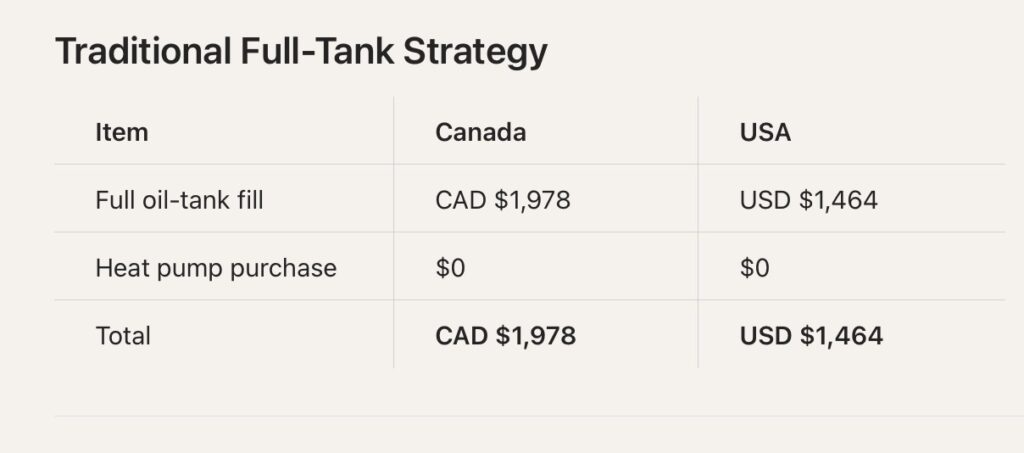
Traditional Full-Tank Strategy
ItemCanadaUSAFull oil-tank fillCAD $1,978USD $1,464Heat pump purchase$0$0TotalCAD $1,978USD $1,464
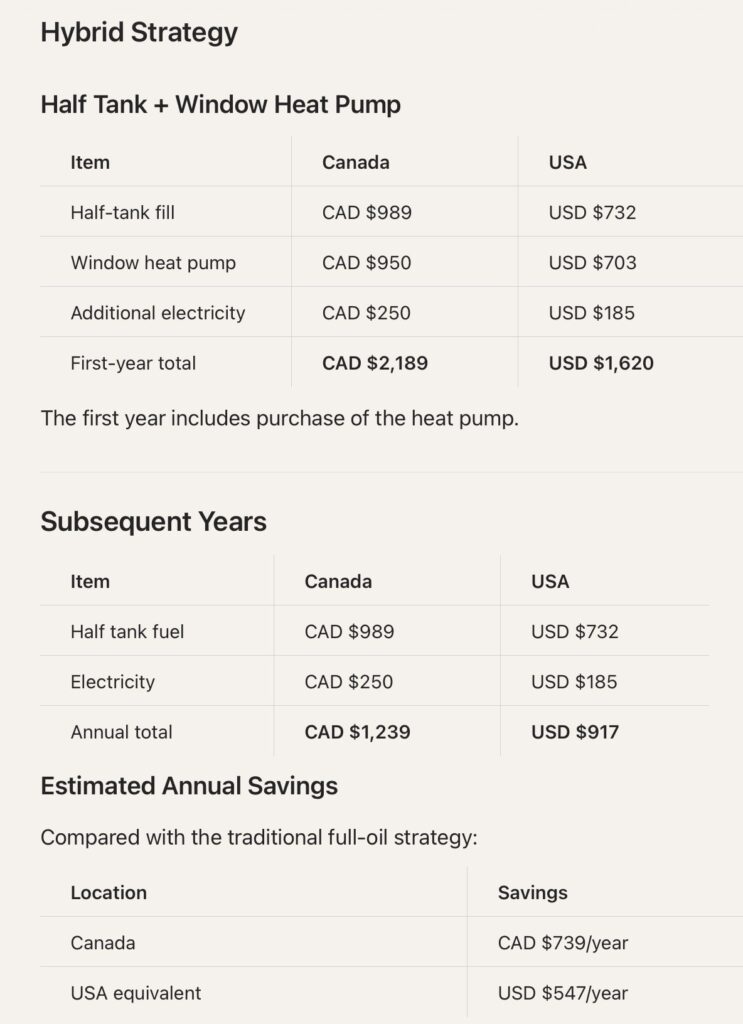
Hybrid Strategy
Half Tank + Window Heat Pump
ItemCanadaUSAHalf-tank fillCAD $989USD $732Window heat pumpCAD $950USD $703Additional electricityCAD $250USD $185First-year totalCAD $2,189USD $1,620
The first year includes purchase of the heat pump.
Subsequent Years
ItemCanadaUSAHalf tank fuelCAD $989USD $732ElectricityCAD $250USD $185Annual totalCAD $1,239USD $917
Estimated Annual Savings
Compared with the traditional full-oil strategy:LocationSavingsCanadaCAD $739/yearUSA equivalentUSD $547/year
Actual results depend on fuel prices, weather conditions, insulation levels, thermostat settings, and heat-pump performance.
Sources
Seattle Clean Heat Program
Seattle Clean Heat Rebates
Seattle Oil-Heat Phase-Out Goals
Seattle Mailer and Outreach Material
- Clean Heat Program mailer: https://citylink.seattle.gov/documents/Departments/OSE/Building%20Energy/Oil/Insert%20Mailer%20vertical_Final.pdf
Tariff Background
- U.S. tariff overview discussing continued trade measures affecting solar equipment and consumer products:
Editorial note: The cost estimates above are illustrative planning figures, not financial advice. Fuel prices, electricity rates, equipment costs, exchange rates, and future tariff policies can materially affect the results. The opinion portions of this article represent an analysis of heating-system choices and not a statement of government policy or engineering recommendation.


