A practical guide to AI’s branches, its political and economic consequences, its effect on finance and law, civic self-protection, election integrity, and the Catholic Church’s ethical perspective.

What Is Artificial Intelligence?
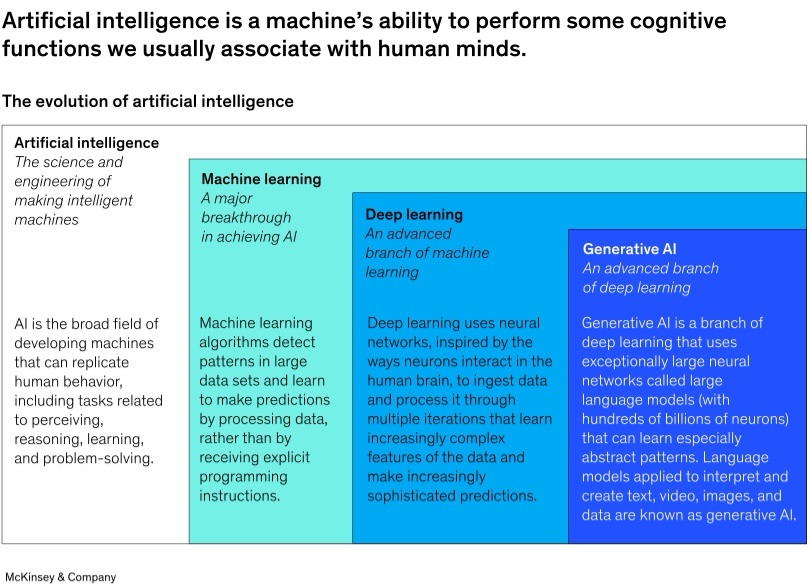
Artificial intelligence, or AI, is a broad field of computing concerned with building systems able to perform tasks associated with human intelligence: perceiving information, learning from patterns, reasoning, predicting, generating language or images, and taking goal-directed actions. The U.S. Congressional Research Service describes AI generally as computerized systems that work and react in ways commonly associated with intelligence, including complex problem-solving in real-world settings. Read the Congressional Research Service overview of AI.
AI is not one thing, and most present-day systems are not human-like minds. They are usually “narrow AI”: tools that can do a particular kind of task very well, but that do not possess human judgment, conscience, responsibility, lived experience, or a dependable understanding of truth.
A chatbot may write in a persuasive, human-sounding voice. That does not mean it knows what it is saying in the way a person does. It predicts plausible language based on patterns in its training data. This can be useful for drafting, research assistance, translation, organization, and brainstorming—but it also means the system can confidently produce errors, invented quotations, false citations, or misleading summaries.
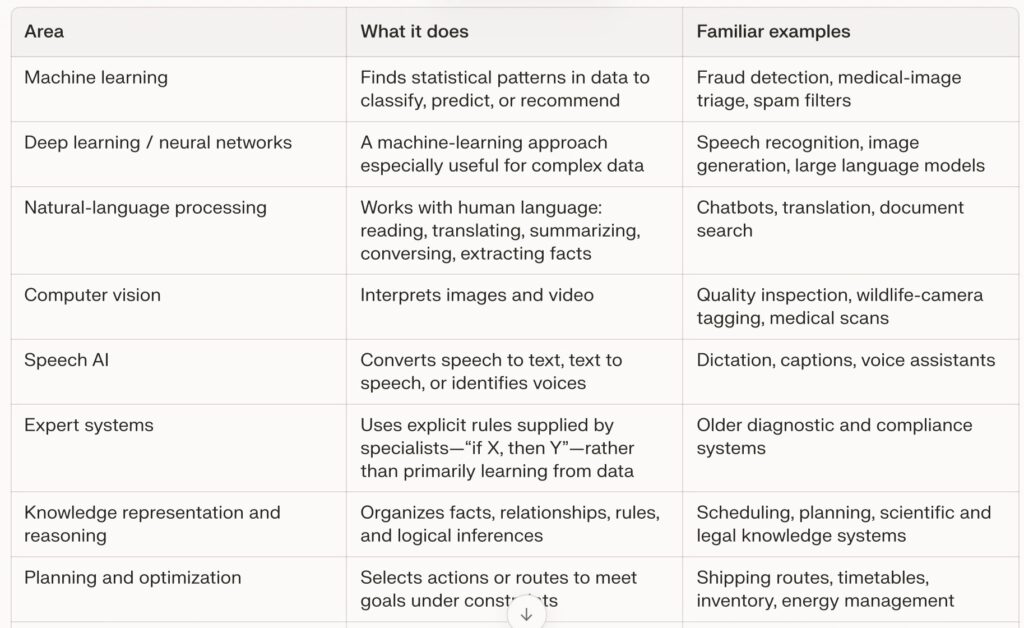
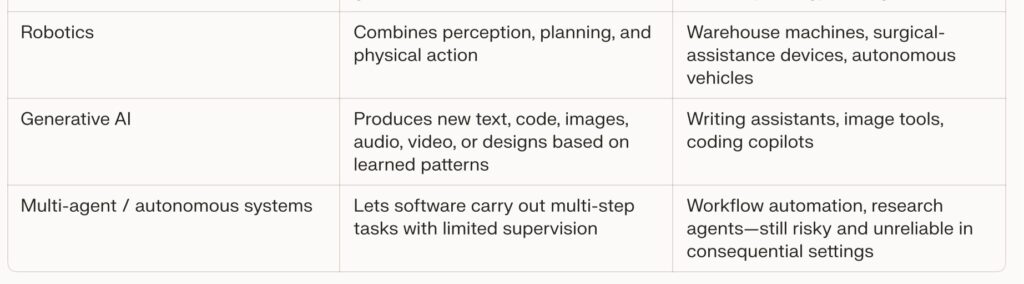
Main Branches of AI

Branch of AI What It Does Common Examples Machine Learning Finds patterns in data to make classifications, predictions, or recommendations. Spam filters, fraud detection, recommendations, insurance analysis. Deep Learning and Neural Networks Uses layered computational models to handle complex patterns in large data sets. Speech recognition, language models, image recognition, image generation. Natural Language Processing Works with human language: reading, translation, summarizing, extracting information, and conversation. Chatbots, transcription, machine translation, document search. Computer Vision Analyzes and interprets images and video. Medical scans, wildlife cameras, facial recognition, industrial inspection. Speech AI Converts spoken words to text, text to speech, or analyzes vocal patterns. Dictation, captions, voice assistants, voice cloning.
Expert Systems Uses explicit expert-created rules, such as “if this condition exists, then take this action.” Older diagnostic tools, compliance systems, troubleshooting programs. Knowledge Representation and Reasoning Organizes facts, rules, concepts, and relationships so a system can draw structured conclusions. Planning systems, legal knowledge bases, scientific databases. Planning and Optimization Chooses actions, schedules, routes, or resource allocations under constraints. Shipping routes, airline schedules, delivery systems, energy management. Robotics Combines sensing, planning, decision-making, and physical movement. Warehouse robots, surgical assistance, autonomous vehicles. Generative AI Creates new text, code, images, audio, video, music, or designs. Writing assistants, image tools, coding assistants, synthetic media. Autonomous or Multi-Agent Systems Attempts to carry out multi-step tasks with limited human supervision. Automated research workflows, business-process agents, monitoring systems.
For a useful introduction to AI’s applications and policy implications, see the Council on Foreign Relations backgrounder on artificial intelligence.
Was AI Initially Feared and Doubted?
Yes. AI has been met with both excitement and skepticism since its modern beginnings. The term “artificial intelligence” is usually associated with John McCarthy and the Dartmouth research project of 1956. Early researchers often predicted rapid progress toward machine intelligence, but those predictions exceeded what computers, algorithms, data, and scientific knowledge could accomplish at the time.
Repeated cycles of overpromising and disappointment produced periods known as “AI winters,” when research funding and public confidence dropped. Much of that skepticism was sensible. Early systems could perform narrow, controlled tasks but struggled with common sense, real-world ambiguity, causal reasoning, and transferring knowledge from one situation to another.
The fears were also longstanding:
- Automation could displace workers or reduce skilled work to monitored routines.
- Algorithms could embed bias and make unfair decisions difficult to challenge.
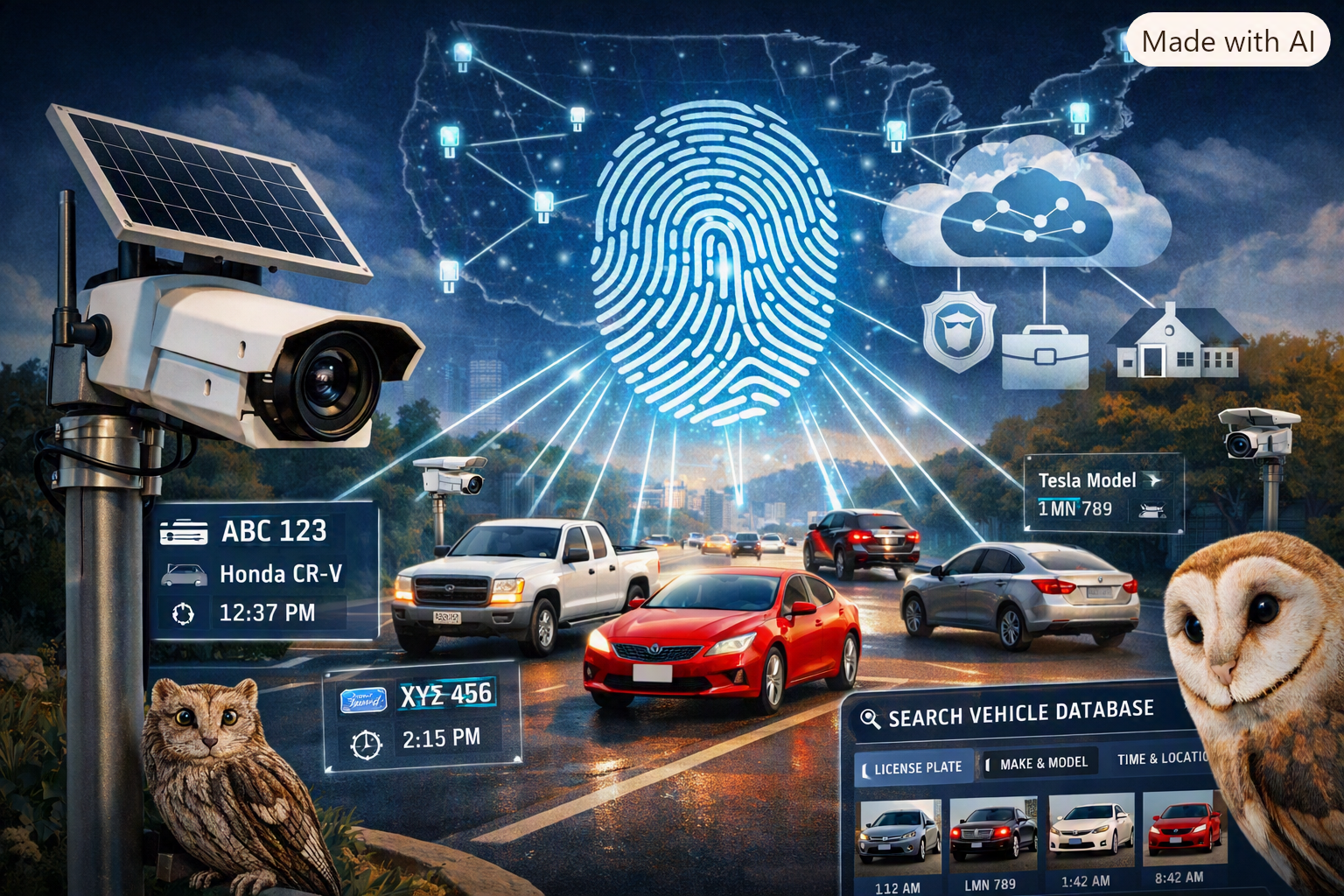
- Governments and corporations could expand surveillance.
- People could lose meaningful control over important decisions involving credit, employment, benefits, policing, or health care.
- AI-generated media could make it harder to distinguish real evidence from fabrication.
Today’s debate is more urgent because AI systems are cheap enough, persuasive enough, and widespread enough to affect daily work, commerce, education, information, finance, law, and politics.
Why AI Has Become Political
AI is political because it affects the distribution of power. It affects who controls information, who owns critical infrastructure, who profits from automation, who is monitored, who gets access to credit or employment, and who can influence public opinion.
Power is “the possibility of imposing ones will upon the behavior of other persons”.- from Max Weber on Law in Economy and Society page 323
It is important to classify different kinds of power so that students of leadership and management can be instructed in the appropriate use of power.
Compensatory Power
This is the ability to reward team members who accept the will of the leader or manager. It may take the form of praise, cash, a corner office, a title, control over schedule and priorities, recommendations, choice of the next assignment, promotion, or any number of things that encourage the desired behavior from a team member.
Condescension Power
This is the opposite of compensatory power but should be considered different than discipline because it is personal where discipline may not be. The team member can learn from discipline; condescension power does not provide an opportunity for team member improvement by learning. Condescension power threatens team members with something emotionally painful or even physically painful so that individuals will submit to the will of the leader or manager. AI is particularly good at generating text used in exerting this power.
Expert Power
This is the power that comes from knowledge that is appropriate for the task at hand. For example, a physician has expert power over patients and allied health professionals owing to the years and years of education, training, and practice that he or she has obtained. This same physician may not have expert power in other areas, such as hospital administration or management. Individuals with expert power may need to adjust their decision making styles in situations where they do not have expertise, but are expected to lead. AI is particularly good at generating the voice and recommendations of experts such as lawyers, doctors, financial planners, detectives, judges, real estate agents, teachers, vacation planners, insurance claims adjudicators, loan agents, etc.
Position Power
This is acceptance of the will of the leader or manager that is based on social conditioning. Most societies teach children the notion of rank which is a formal designation of who has power over who by ones position in a hierarchy. Military professionals are specially trained to accept position power which is necessary in battle. Position power to often is used for crime but here AI can be used to diminish it. Actors can question AI to determine if they should follow illegal orders.
Referent Power
The leader or manager with referent power is the one that others refer to owing to goodwill and mutual respect. It comes from a successful track record over a period of time involving common interests between individuals. Good examples involve organized religion, the Catholic Pope for example but also heads of households.
The central political questions include:
- Who owns the data used to train and operate AI systems?
- Will a small number of technology companies control the models, cloud infrastructure, computer chips, and information channels on which society depends?
- Will workers be displaced, deskilled, surveilled, or empowered?
- Can a citizen appeal an algorithmic decision affecting a loan, job, insurance policy, government benefit, or legal matter?
- Can campaigns use deepfakes, voice cloning, automated propaganda, and micro-targeted persuasion to confuse voters?
- Who is legally and morally responsible when an AI-assisted decision harms someone?
AI intersects with civil liberties, antitrust law, labor rights, consumer protection, national security, public education, and election law. That is why it has become one of the defining political and civic issues of the era.
For an overview of election-related AI concerns and state responses, consult the National Conference of State Legislatures guide to AI in elections and campaigns.
Does AI Threaten Cryptocurrency?
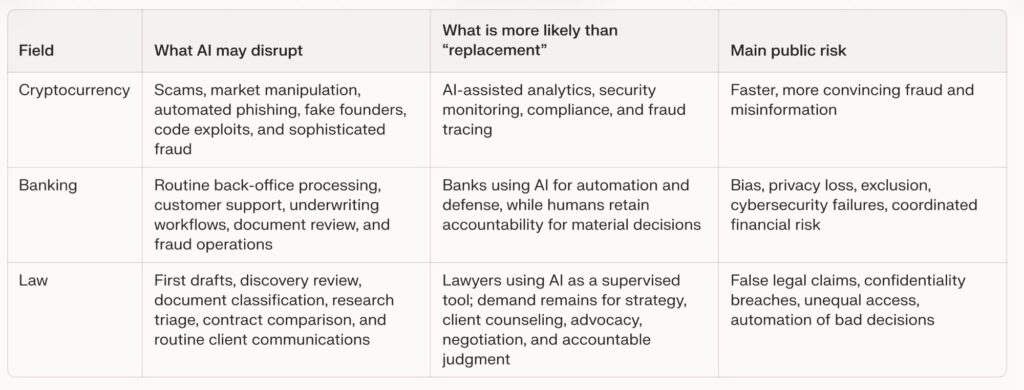
AI does not necessarily threaten the idea of cryptocurrency itself, but it can make the cryptocurrency environment more dangerous. It can make scams, impersonation, phishing, synthetic endorsements, fake investment pitches, code exploits, and market-manipulation campaigns more sophisticated and more convincing.
AI can also be used constructively: to identify suspicious transactions, detect fraud patterns, audit smart contracts, monitor threats, and help investigators trace criminal activity. The problem is that criminals can use the same tools to operate faster and at larger scale.
Consumers should treat every urgent message, supposed endorsement, video testimonial, social-media post, “customer support” chat, and promise of guaranteed returns with suspicion. Never reveal a wallet seed phrase. Verify transaction addresses independently. Use strong account security. Do not assume that a polished video or realistic voice recording is genuine.
For context on crypto-related illicit finance, see the TRM Labs Crypto Crime Report. Private-sector estimates vary by methodology, so any numerical estimate should be read as an informed assessment rather than unquestionable fact.
Does AI Threaten Banking?
AI is more likely to transform banking than to eliminate it. Banks have used automated systems for years in fraud detection, credit scoring, customer service, compliance, anti-money-laundering operations, and risk management. Newer AI systems may automate more routine work, including document review, call-center functions, underwriting support, and transaction monitoring.

The larger concern is whether banking decisions become opaque, unfair, or impossible to appeal. AI can amplify errors in credit decisions, expose private financial information, make phishing attacks more convincing, and create dependence on a small number of technology vendors.
A responsible banking system should preserve a meaningful human review process for consequential decisions. Consumers should be able to understand why they were denied credit, charged a particular rate, flagged for fraud, or blocked from an account—and should have a practical way to challenge an error.
The National Institute of Standards and Technology has developed an AI Risk Management Framework to help organizations manage AI risks to individuals, organizations, and society. Read the NIST AI Risk Management Framework.
Does AI Threaten Legal Professions?
AI will change legal work, especially the routine work of reviewing documents, sorting evidence, summarizing material, comparing contracts, drafting first versions of filings, and conducting preliminary research. It does not eliminate the need for lawyers, judges, advocates, mediators, and accountable human judgment.
Law involves more than retrieving words from documents. It involves judgment, client counseling, strategy, ethical obligations, negotiation, advocacy, evidence, credibility, and responsibility to courts and clients.
The American Bar Association has emphasized that lawyers’ existing professional duties still apply when they use generative AI. Those duties include competence, confidentiality, communication with clients, supervision, accuracy, and reasonable billing practices. Read the American Bar Association’s announcement of Formal Opinion 512.
AI-generated legal text should never be submitted to a court or relied upon in a serious matter without checking every factual claim, case citation, quotation, legal rule, and jurisdictional requirement. For questions involving liberty, family, property, employment, debt, injury, or major rights, consult a qualified attorney.
How Consumers Can Use AI Against Concentrated Power
AI can help people protect their lifestyles and communities from monopolistic, oligarchic, or exploitative systems—but only when it increases ordinary people’s capacity to understand, compare, document, organize, and act. It should not become another tool for surveillance, manipulation, or unaccountable decision-making.
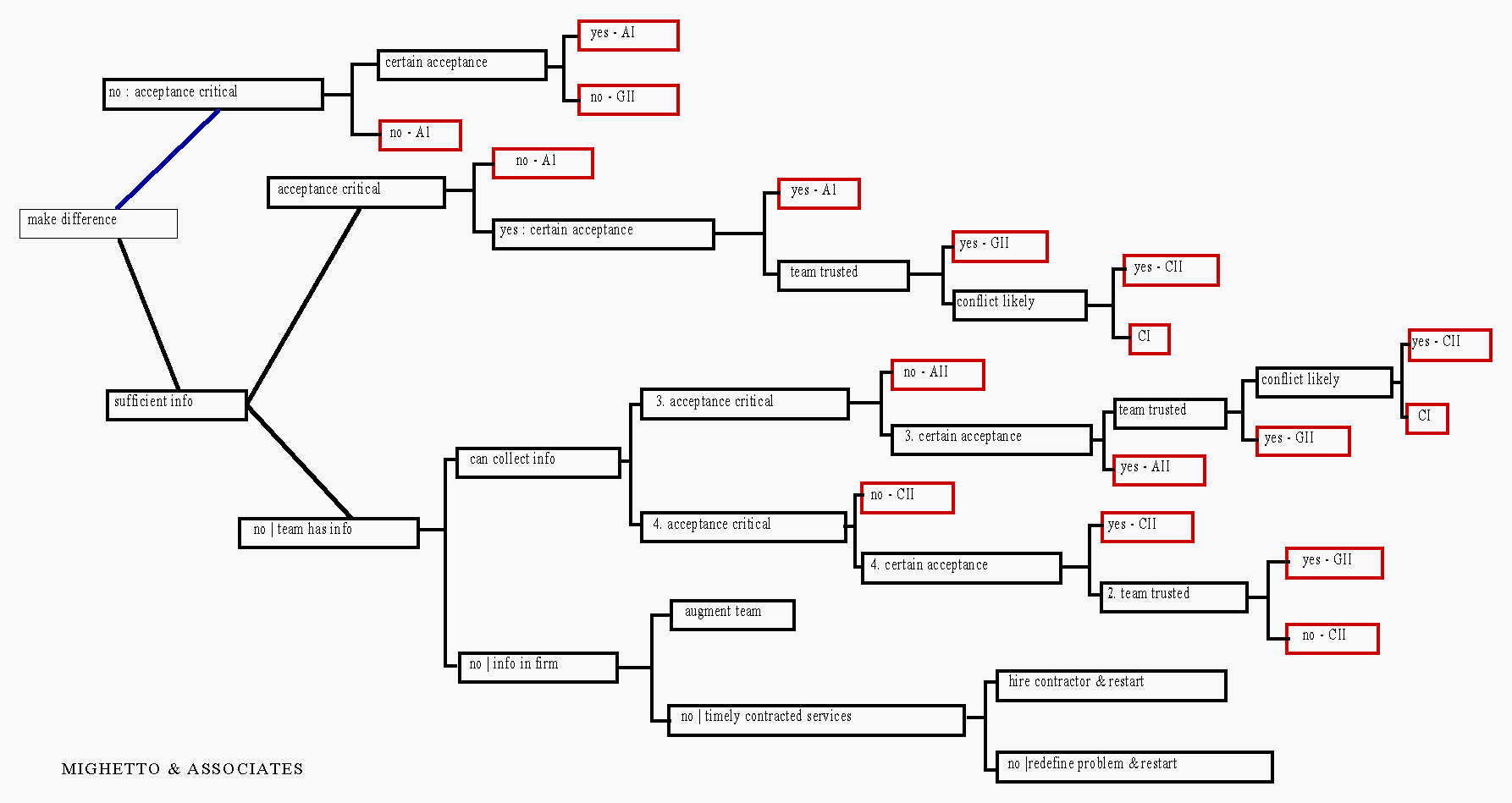
A decision tree is a map of the reasoning process. It can be used to explain why a question is being asked. The following decision tree assumes that questions are answered with a certain yes or no. A tree that allows answering with a partial yes or no would have a much larger number of end nodes. In real world problems, the intuition of a human expert, or expert system software, is necessary to determine the likely end node. Each end node represents a situation with known effective and efficient leadership styles.
Practical Uses for Citizens
- Use AI to translate leases, insurance policies, medical bills, bank agreements, subscription terms, and utility notices into plain English.
- Compare prices, fees, contract terms, service quality, and ownership structures among local and national providers.
- Draft consumer complaints, public-records requests, appeal letters, billing disputes, and requests for correction of inaccurate personal information.
- Summarize city council agendas, port authority meetings, zoning filings, environmental reviews, proposed marina changes, and public hearing materials.
- Organize research into campaign finance, corporate ownership, lobbying, public contracts, mergers, and rate increases.
- Help local organizations produce accessible guides, meeting summaries, multilingual explanations, and educational material.
- Assist journalists, researchers, and neighborhood groups in organizing large collections of public documents.
For communities concerned with public waterfronts, marinas, ferry service, public access, habitat protection, or shoreline development, AI can reduce the clerical burden of reading lengthy planning documents. It can turn a meeting packet into a list of dates, agencies, proposed actions, affected places, public-comment deadlines, and questions that still need to be answered.
But it should never replace source reading. A responsible citizen uses AI to find and organize leads, then checks primary records, attends meetings, contacts public officials, speaks with affected people, and preserves an evidence trail.
A Simple Verification Method
- Ask the AI to distinguish facts from opinions and inferences.
- Require it to provide sources, dates, and direct quotations.
- Read the underlying documents yourself.
- Look for a credible contrary source or competing explanation.
- Save original records and keep notes about where claims came from.
- Make the final decision through accountable human judgment.
Do not paste unredacted financial records, tax returns, medical files, passwords, confidential client material, unpublished research, or private correspondence into a public AI system.
Can AI Prevent Criminals From Being Elected?
AI should not decide who is criminal, who may run for office, or whom voters should support. A system that assigns “criminality scores” to political candidates would be highly vulnerable to bias, false accusations, defamation, partisan abuse, selective enforcement, and authoritarian misuse.
In a democracy governed by law, allegations and disqualifications should rest on transparent evidence, legally authorized procedures, due process, independent review, and the opportunity to challenge false claims.
AI can nevertheless assist legitimate civic oversight when it is used carefully and transparently. It can help journalists, watchdog organizations, researchers, and voters organize public information such as:
- Public court records and final judicial findings.
- Campaign-finance disclosures.
- Ethics investigations and official reports.
- Government procurement records and conflicts of interest.
- Voting records and public statements.
- Reliable investigative reporting and source documents.
- Potentially synthetic audio, video, or images that require verification.
The proper civic standard is not automated suspicion. It is verified public evidence, fair process, independent journalism, voter education, and institutions that enforce the law equally.
What the Catholic Church Says About AI
The Catholic Church does not treat AI as inherently evil or inherently good. Its moral value depends on how people design, deploy, regulate, and use it. The Church’s central concern is whether AI serves human dignity, the common good, justice, freedom, solidarity, and the integral development of the human person.
Pope Leo XIV has said that the benefits and risks of artificial intelligence must be evaluated in light of the “integral development of the human person and society,” including material, intellectual, and spiritual well-being, as well as the inviolable dignity of every person. Read Pope Leo XIV’s 2025 message on AI, ethics, and corporate governance.
This approach suggests several moral principles:
- Human beings must never be reduced to data points, risk scores, consumer profiles, or replaceable economic inputs.
- AI should assist human beings rather than weaken human agency, freedom, relationships, creativity, and responsibility.
- High-stakes decisions affecting people’s lives should remain subject to human accountability and meaningful appeal.
- Children, workers, poor communities, and politically marginalized people deserve particular protection from exploitation, surveillance, manipulation, and exclusion.
- Technology should serve the common good rather than only profit, control, military advantage, or ideological power.
- Ethical principles require enforceable law, transparent governance, independent oversight, and informed citizens—not merely corporate promises.
In short, the Catholic question is not merely, “Can we build this?” It is: “Does this technology honor the human person, protect the vulnerable, strengthen just community, and keep moral responsibility with human beings?”
Conclusion: Use AI, But Do Not Surrender Judgment
AI can be an important tool for research, writing, accessibility, consumer advocacy, fraud detection, public oversight, and community organizing. It can also be used to deceive, concentrate wealth, automate discrimination, erode privacy, and distort elections.
The answer is neither blind faith in technology nor blanket rejection. The answer is informed use, independent verification, strong privacy protections, democratic oversight, professional accountability, public-interest journalism, and laws that protect human beings from exploitation.
Use AI to make yourself and your community harder to mislead, overcharge, isolate, surveil, or silence. Do not use it to automate suspicion, spread unverified accusations, replace human responsibility, or surrender civic judgment to a machine.
Selected Resources
- Congressional Research Service: Overview of Artificial Intelligence
- Council on Foreign Relations: What Is Artificial Intelligence?
- National Institute of Standards and Technology: AI Risk Management Framework
- American Bar Association: Ethics Guidance on Generative AI
- National Conference of State Legislatures: AI in Elections and Campaigns
- Pope Leo XIV: Message on Artificial Intelligence, Ethics, and Corporate Governance
- TRM Labs: Crypto Crime Report


David Sacks says that the combination of administrative state, criminal courts, and civil courts are enough to control bad behavior on the AI frontier, which consists of basically two firm – Anthropic and Open AI. If executives at those companies want to slow efforts down to protect themselves fine but asking for exemptions to anti-trust (which they want) to do is ill advised.
Trump suggested there’s “a SICK conspiracy going on against AI and Data Centers, and the only one that is happy about it is China.” See Trump says a strong, smart president is the only “guardrail” AI needs at https://www.axios.com/2026/09/14/trump-ai-safety-anthropic-dario-amodei?utm_source=flipboard&utm_content=AxiosNews/magazine/Axios
Most of the Fed agencies want to slow down AI innovation. Trump’s opposite stand may come from realization that any action would require new Federal budget for staff. No action requires no funding. The history of AI since the 1950s shows growth spirts followed by inaction. This could be the same situation. Let’s support Trump for now,