How a Single Surveillance Company Became the Most Controversial Name in American Policing
The Camera That Sees Everything
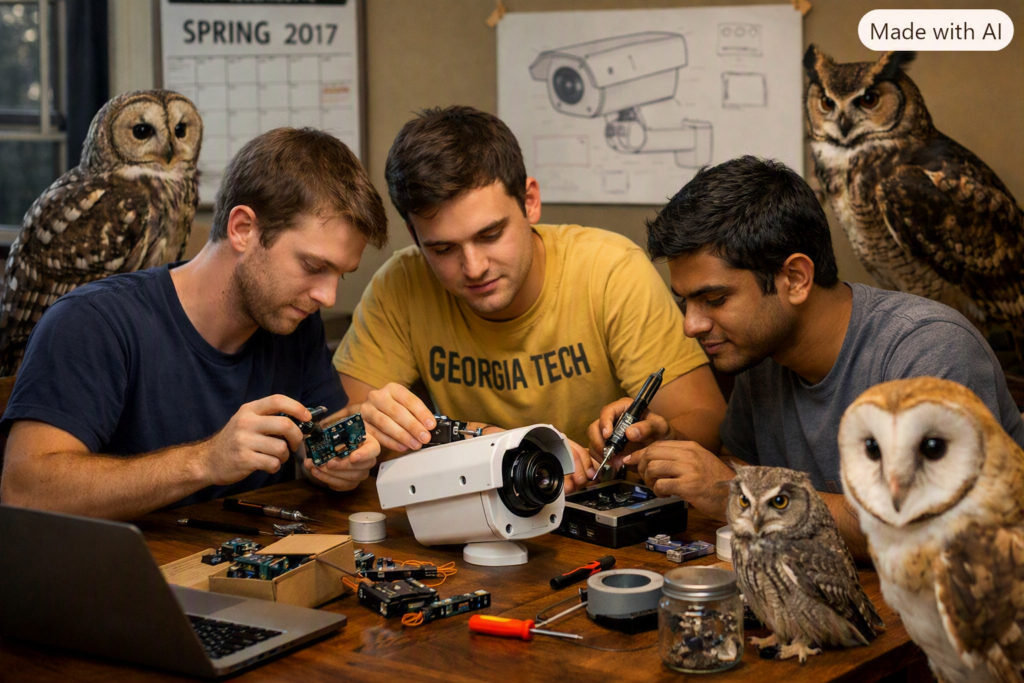
In the spring of 2017, three Georgia Tech alumni built their first surveillance camera by hand around a dining room table in Atlanta. They had no idea that within eight years, their company — Flock Safety — would be valued at $8.4 billion, deployed in more than 6,000 American municipalities, and at the center of one of the most explosive privacy debates in modern policing.
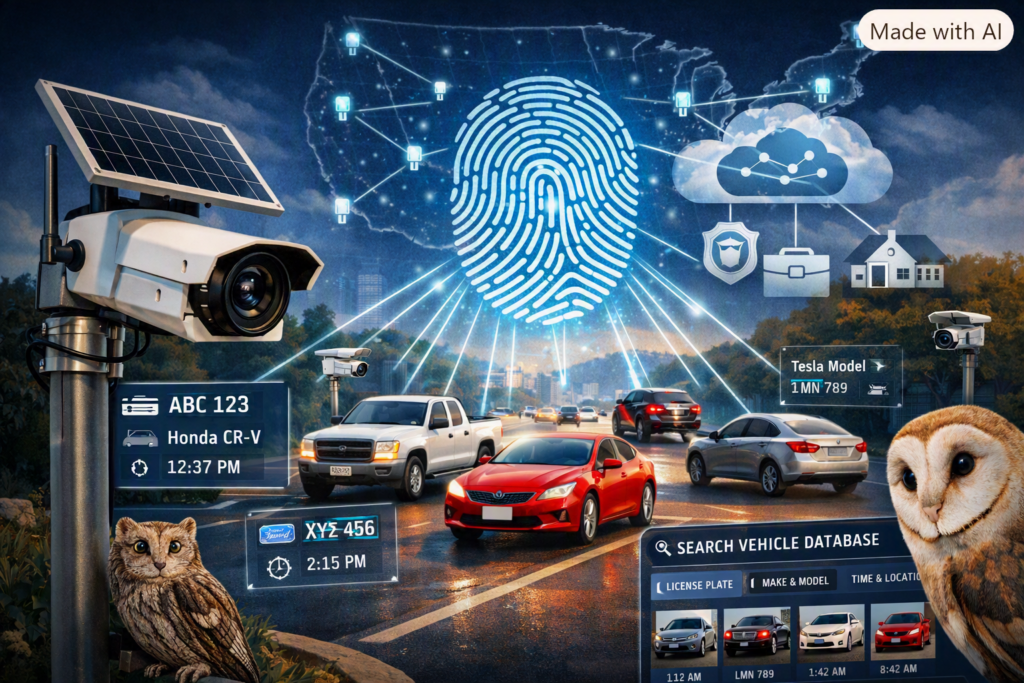
Flock’s product is deceptively simple: solar-powered cameras that read license plates, identify vehicle make and model, and log the time and location of every passing car. The company calls this “vehicle fingerprint technology.” What makes Flock different from traditional security cameras is the network effect — each camera feeds into a cloud-based database searchable by thousands of law enforcement agencies, private businesses, and neighborhood associations across the country using AI.
The pitch was irresistible to city councils and police chiefs: reduce crime by up to 70 percent, solve cases faster, and deploy cameras anywhere without wiring or IT infrastructure. Cities from Austin to Seattle signed contracts. Home Depot, Lowe’s, and Simon Properties installed them in parking lots. School districts mounted them on campuses. By early 2026, Flock cameras were capturing over one billion vehicle readings per month.
But beneath the marketing of community safety lay a more troubling architecture — one that would soon entangle the company in lawsuits, mass surveillance scandals, and a nationwide rebellion by the very cities that had invited it in.
The Three Doors: How ICE Found Its Way In
For years, Flock Safety insisted it had no direct contracts with Immigration and Customs Enforcement (ICE). CEO Garrett Langley publicly denied federal partnerships. The claim, it turned out, was technically true and fundamentally misleading.

In May 2025, investigative reporting revealed that local police departments across the country were performing lookups in Flock’s database on behalf of ICE — searches that only surfaced because officers had typed “ICE,” “illegal immigration,” or similar terms into the required search justification field. These “side door” searches gave federal immigration agents indirect access to a surveillance tool they had no formal right to use.

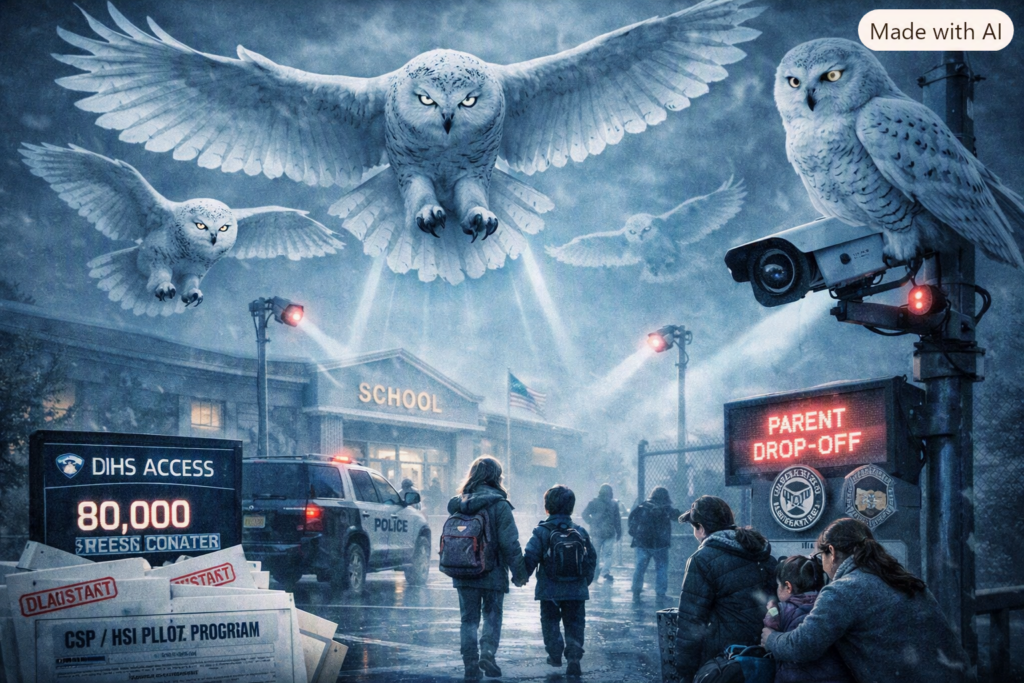
Then, in August 2025, Flock admitted to running undisclosed pilot programs with U.S. Customs and Border Protection (CBP) and Homeland Security Investigations (HSI) — both agencies under the Department of Homeland Security alongside ICE. These pilots allowed federal agents to regularly search more than 80,000 Flock cameras. The revelation contradicted years of public assurances.
Researchers at the University of Washington Center for Human Rights identified three distinct pathways of federal access in Washington state alone: “front door” sharing agreements where at least eight local agencies enabled direct data sharing with U.S. Border Patrol; “back door” access where CBP reached data from at least ten agencies that had never authorized it; and the “side door” searches by proxy.
The national network itself became a loophole. Even cities that explicitly barred immigration enforcement found their data accessible to agencies in other jurisdictions. In Virginia, law enforcement conducted nearly 3,000 immigration-related searches on the state’s Flock network in a single year.
The Human Cost
The consequences of this surveillance architecture have been devastating for ordinary families. License plate reader data has become a routine tool in ICE’s location and identification of targets — frequently cited in immigration enforcement records as a primary investigative method.
Perhaps most chilling was the weaponization of school surveillance. A joint investigation by The 74 and The Guardian revealed that police departments were leveraging school district security cameras — including those contracted through Flock — to assist immigration enforcement. Audit logs showed officers searching the national database for immigration-related investigations, with families being targeted during school drop-offs and pick-ups.
The surveillance doesn’t just affect undocumented immigrants. ALPRs create comprehensive records of where everyone drives — which doctors they visit, which houses of worship they attend, which political meetings they participate in, and who they associate with.
There have been cases of mothers and children held at gunpoint because ALPR cameras wrongly flagged their vehicles as stolen.
The Revolt of the Cities
By early 2026, the backlash had reached a tipping point. At least 30 localities had deactivated Flock cameras or canceled contracts since the beginning of 2025.

In Seattle, the rebellion took on particular urgency. Mayor Katie Wilson, who had campaigned on stopping surveillance expansion, faced pressure from campaign volunteers who feared the cameras could be “weaponized by the federal government.” In March 2026, Wilson announced she was halting the addition of new police CCTV cameras and turning off automatic license plate reader technology on roughly 400 police patrol and parking enforcement cars.

Wilson kept one exception — 22 CCTV cameras in the Stadium District installed before the 2026 FIFA World Cup — but stipulated they would only be activated in case of a “credible threat.” She also ordered one camera near a reproductive health clinic turned off over privacy concerns.
The Seattle Police Department’s leadership did not survive the turmoil. Chief Shon Barnes resigned under pressure in July 2026, as frustrated residents erected homemade barricades to keep traffic out amid crime concerns and the surveillance debate reached a boiling point.

While the resignation appeared to stem from broader tensions over policing and surveillance policy rather than Flock support specifically, it underscored the political price of embracing unchecked surveillance.
Other cities followed in rapid succession. Austin, Denver, Evanston, and Scarsdale canceled contracts in 2025. In 2026, Santa Cruz, Mountain View, Berkeley, Cambridge, Olympia, and Charlottesville joined them.

Mountain View suspended its program after discovering federal and out-of-state agencies had accessed city data without authorization.
Berkeley voted to cancel contracts for 52 cameras in April 2026. Brooklyn Park and Columbia Heights, Minnesota, ended their contracts entirely.

LAustin, Denver, Evanston and Oak Park, Illinois, and Scarsdale, New York…
In 2026: Flagstaff (Arizona), Oak Park (Illinois), Cambridge (Massachusetts), and Olympia (Washington), City of Santa Cruz in January 2026
Many of these cities are sanctuary jurisdictions or operate under state laws — like Washington’s Keep Washington Working Act and California’s privacy restrictions — that explicitly forbid sharing license plate data with federal immigration enforcement, making Flock’s data-sharing practices legally untenable.
The Courts Take Notice
The legal reckoning has been equally swift. In early 2026, the Oakland-based law firm Gibbs Mura filed a class action lawsuit against Flock Safety alleging violations of California privacy laws.
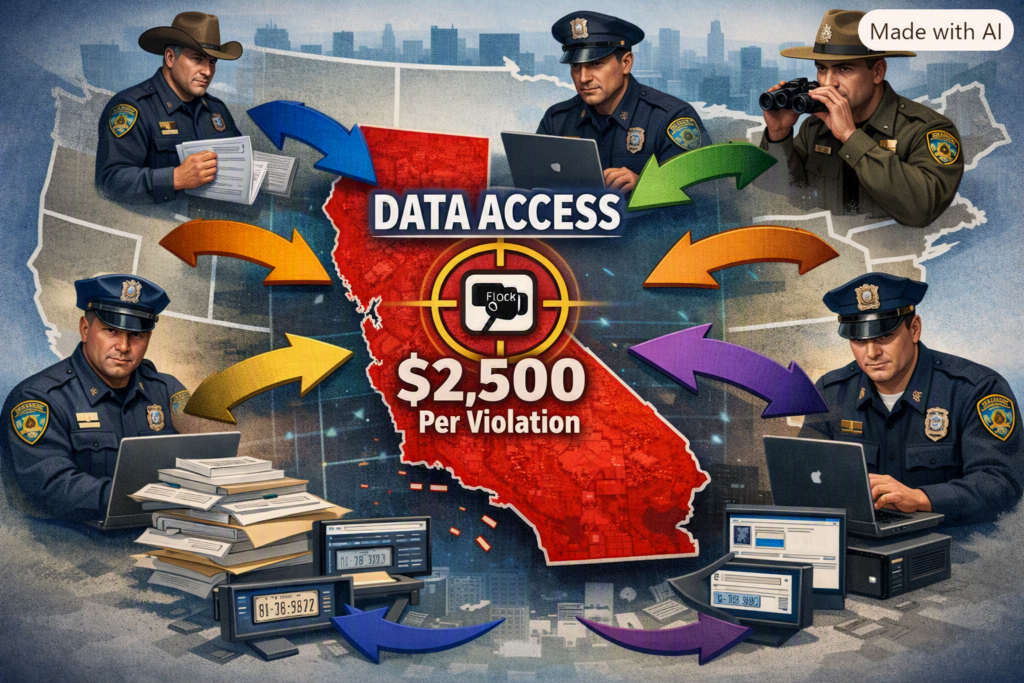
The suit claims out-of-state agencies searched the San Francisco Police Department’s Flock database more than 1.6 million times in seven months, and that Los Altos shared data with out-of-state agencies over a million times. Under California law, affected individuals can sue for a minimum of $2,500 per violation plus punitive damages.
California Attorney General Rob Bonta sued the City of El Cajon in October 2025 for systematically violating state law by sharing Flock ALPR data with out-of-state agencies.

In Oakland, the nonprofit Secure Justice sued the police department for providing federal agencies direct access to ALPR data through tools like Crime Tracer and the Northern California Intelligence Regional Center, which hosts FBI, IRS, DEA, and other federal agents.
Flock has stated it “takes privacy, legal compliance, and data security extremely seriously” and intends to “vigorously defend itself against the asserted claims.”
The Billionaires Behind the Lens
Flock Safety’s $8.4 billion valuation did not emerge from nowhere. The company has raised approximately $1.17 billion across multiple funding rounds from 32 institutional investors.
While founders Garrett Langley and Matt Feury retain operational control through super-voting shares, venture capital firms hold the majority economic interest.

The most prominent backers include Andreessen Horowitz, the Silicon Valley firm co-founded by billionaire Marc Andreessen, which has led multiple funding rounds including the $275 million Series H in March 2025.
Tiger Global Management, estimated to hold 12-18% of the company, led the $150 million Series D in 2021.
Bedrock Capital, founded by Geoff Lewis, was an early investor who personally flew to Atlanta in 2018 to convince Langley to take his firm’s money.
The most politically charged association involves Peter Thiel, the billionaire co-founder of PayPal and Palantir. Thiel’s venture firm, Founders Fund, invested in Flock’s spring 2025 fundraising round.

The connection has drawn criticism given Thiel’s stated anti-democratic views and support for surveillance technologies — though a fact-check by the Colorado Sun clarified that Thiel has never served on Flock’s board and did not help start the company.
Other notable investors include Kleiner Perkins, Y Combinator, Matrix Partners, Greenoaks Capital, and Axon Enterprise — the latter itself a major player in police technology.
Beyond America’s Borders
For all its dominance in the United States, Flock Safety remains overwhelmingly a domestic operation. The company has contracts with more than 5,000 law enforcement agencies across 42 states, but its international footprint is minimal.
According to growth strategy analyses, Flock has launched pilot programs in Canada and the United Kingdom — jurisdictions chosen for privacy regimes similar enough to the U.S. to ease regulatory entry.

However, the company does not currently operate in Australia, where commentators have noted that Flock “wouldn’t comply with our cyber security requirements anyway.”
Flock’s expansion strategy remains focused on deepening density in American cities, targeting retail chains for organized crime prevention, and integrating drones through its 2024 acquisition of Aerodome. The company is projected to pursue an IPO in 2026-2027 if market conditions remain favorable — a milestone that would make its surveillance network a publicly traded commodity.
The Unfinished Debate
The story of Flock Safety is, in many ways, the story of American policing in the 2020s: the tension between public safety and civil liberties, the privatization of surveillance infrastructure, and the gap between what technology companies promise and what their systems actually do. Cities that installed Flock cameras hoping to deter car theft found themselves unwitting participants in a national immigration dragnet. School districts seeking to protect students discovered their cameras were being used to target families at drop-off.
The camera on the corner was never just about the corner. It was about the network — the invisible architecture of data sharing, federal access, and venture capital that turns a local traffic camera into a node in a surveillance apparatus of staggering scale. As more cities pull the plug and courts begin to weigh in, the question is no longer whether Flock’s technology works. It is whether any democracy can afford to let it.
This article was compiled from public records, investigative reporting by 404 Media, The Guardian, The 74, the University of Washington Center for Human Rights, and court filings as of August 2026.
Here are the references for the essay, numbered in order of first appearance and formatted with embedded links where available:
- Crunchbase. “Flock Safety Company Profile.” Accessed 2026. (Funding data: $1.17B raised to date.)
- Tracxn. “Flock Safety Valuation and Metrics.” Accessed 2026. (Valuation data: $8.4B as of April 2026.)
- University of Washington Center for Human Rights. “Leaving the Door Wide Open: Flock Surveillance Systems Expose Washington Data to Immigration Enforcement.” October 21, 2025.
- Tracxn. “Flock Safety Operations Data.” Accessed 2026. (Data: 1 billion+ vehicle readings captured monthly.)
- NPR. “Why some cities are ditching their Flock license plate readers.” February 17, 2026.
- 404 Media. “ICE Taps into Nationwide AI-Enabled Camera Network, Data Shows.” May 27, 2025.
- Immigration Policy Tracking Project. “Reported: ICE using automated license-plate-reader cameras for immigration enforcement via state/local police.” February 18, 2026. https://immpolicytracking.org/policies/reported-ice-accessing-flock-automated-license-plate-reader-cameras-via-local-law-enforcement/ https://immpolicytracking.org/policies/reported-ice-accessing-flock-automated-license-plate-reader-cameras-via-local-law-enforcement/
- The 74 and The Guardian. “ICE Taps into School Security Cameras to Aid Trump’s Immigration Crackdown.” February 10, 2026.
- 404 Media. “California Cops Investigate ‘Immigration Protest’ With AI-Camera System.” June 17, 2025.
- Office of the Mayor, City of Seattle. “Mayor Wilson announces next steps on surveillance pilot project.” March 19, 2026. https://wilson.seattle.gov/2026/03/19/mayor-wilson-announces-next-steps-on-surveillance-pilot-project/ https://wilson.seattle.gov/2026/03/19/mayor-wilson-announces-next-steps-on-surveillance-pilot-project/
- The Seattle Times. “Mayor Katie Wilson pauses expansion of police surveillance cameras.” March 19, 2026.
- The New York Times. “Seattle’s Police Chief Resigns Under Pressure After Festival Shooting.” July 31, 2026.
- MinneapoliMedia. “Columbia Heights Ends Flock Safety Contract After Residents Force Rethink of Police Surveillance.” June 28, 2026.
- Gibbs Mura, A Law Group, via Business Wire. “Flock License Plate Cameras Face Class Action Lawsuit by Gibbs Mura.” February 27, 2026.
- KTVU Fox 2. “Class action lawsuit alleges Flock license plate readers violate CA law and privacy of residents.” February 27, 2026.
- Secure Justice v. Oakland Police Department. Filed November 2025. (Allegations of direct federal access to ALPR data via Crime Tracer and the Northern California Intelligence Regional Center.)
- The Colorado Sun. “Are Flock and Palantir both owned by billionaire Peter Thiel?” February 13, 2026.
- Tracxn. “Flock Safety Ownership and Investor Data.” Accessed 2026. (Data on institutional investors including Andreessen Horowitz, Tiger Global, Bedrock Capital, and Founders Fund.)
- Bedrock Capital. “The Story Behind Our Flock Safety Investment.” Accessed 2026. (Account of Geoff Lewis’s founding investment in Flock’s 2018 Series A-1.)
- Reddit, r/Denver. “Let’s talk about flock cameras.” Accessed 2026.


