An exploration of how artificial intelligence may be reshaping executive decision-making in the White House.

Introduction
Artificial intelligence has rapidly moved from a technological curiosity to a tool increasingly used by governments, corporations, military organizations, and political leaders for Super Intelligence (SI). While there is no public evidence that the President of the United States has delegated decision-making authority to artificial intelligence, there is growing evidence that AI systems are being consulted by Trump as sources of analysis, forecasting, and policy support.
Recent reporting suggests that President Donald Trump has personally engaged with Elon Musk’s Grok AI system regarding political and geopolitical questions, while the U.S. Department of Defense has expanded access to AI platforms including Grok, ChatGPT, and Gemini for government use.[1][2][3]
This raises a fascinating question: What happens when a president increasingly trusts artificial intelligence more than traditional political advisers?
The Challenge of Presidential Span of Control
Management theorists often use the phrase span of control to describe the number of people, organizations, and decisions a leader can effectively oversee. The President of the United States arguably manages the most complex organization in human history:
- More than four million federal employees and military personnel.
- Multiple intelligence agencies.
- Cabinet departments.
- An economy worth tens of trillions of dollars.
- International alliances.
- Military operations.
- Domestic political coalitions.
Historically, no president could personally absorb all relevant information flowing through such a vast system. Information therefore passes through layers of advisers, chiefs of staff, agency leaders, military officers, economists, and political operatives.
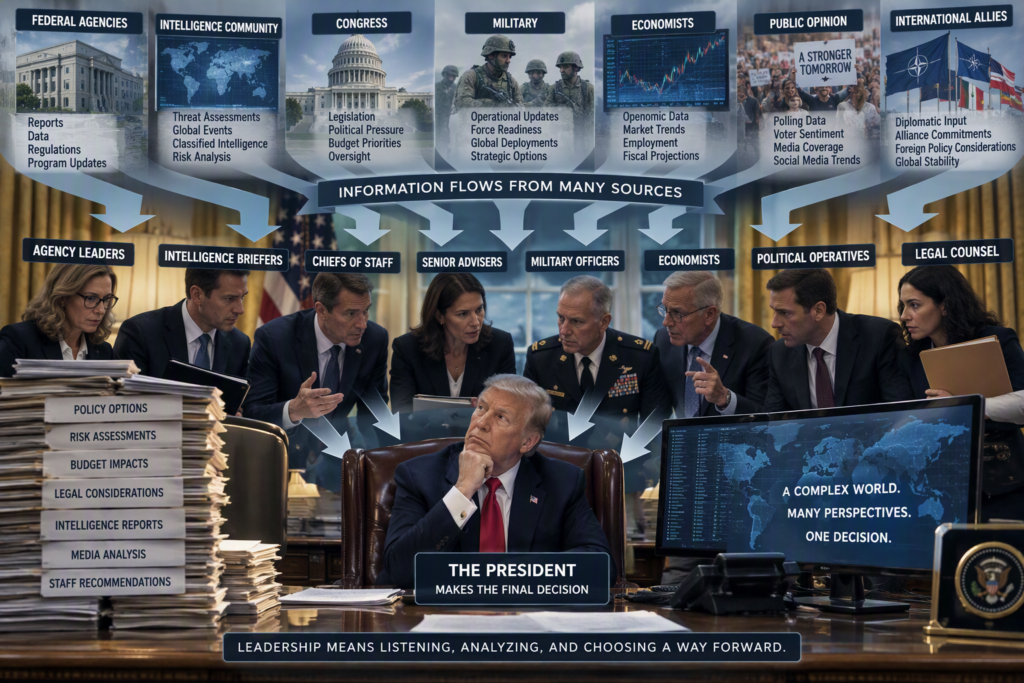
Each layer helps manage complexity but also acts as a filter. Information can become delayed, distorted, politicized, or selectively presented. AI introduces the possibility that a president may obtain a parallel stream of analysis independent of these human filters.
The Emergence of AI as a Presidential Adviser
According to reporting by multiple news organizations, President Donald Trump reportedly spent hours questioning Grok about political and foreign-policy scenarios, including how Venezuelans might react if their president were removed from power.[1][4][5] Whether those conversations influenced policy remains unknown. The reporting only establishes that the discussions occurred.[1] Nevertheless, the significance lies in the precedent. For centuries, rulers depended upon human advisers. Now, a president could ask:
- What are the likely consequences of tariffs? (Note:
Inflation is one of the most commonly expected consequences of tariffs, although the magnitude and timing can vary.) - Which sanctions are most effective? (Note:
Ranking sanctions by likely long-term strategic impact:
1. Technology export controls, 2. Energy-sector restrictions 3. Financial sanctions 4. Asset freezes targeting individuals) - Which cabinet secretary is underperforming? (Note 1.
Department of Defense (DOD), 2. Department of Health and Human Services (HHS) 3. Federal Emergency Management and Disaster Assistance 4. Department of Energy (DOE) 5. Internal Revenue Service / Treasury Functions) - What are emerging trends in energy demand? (Note: In many ways, we’re moving from the Age of Oil toward the “Age of Electricity.” )
- How would financial markets react to a particular action? (Note:
Ironically, an e-dollar could strengthen the dollar’s international position.)
The American Dream at a Crossroads
THE NEW CONFEDERACY OF MONEY
Stablecoins have expanded the dollar’s reach but empowered oligarchs who openly reject one‑person‑one‑vote democracy. They have weakened the government’s ability to punish bad actors, undermined the post‑Civil‑War monetary order, and accelerated a shift toward private governance, private enforcement, and private money. If the U.S. eventually introduces an e‑dollar, it may restore democratic control over digital currency. But the longer stablecoins dominate, the more entrenched oligarchic monetary power becomes—and the harder it will be to reclaim. The American Dream was built on the idea that citizens, not oligarchs, shape the nation’s future. Stablecoins test whether that dream still holds.
Instead of convening multiple staff meetings, an AI system might generate a synthesized answer in seconds.
Personnel Decisions and Requests for Resignation
One area where AI could prove especially attractive to a president is personnel management. Every administration experiences internal conflict. Cabinet secretaries, agency heads, ambassadors, and senior staff may lose influence, fail to execute policy, or fall into political controversy. Traditionally, presidents rely on trusted aides to evaluate officials. An AI-driven assessment process might look different. Instead of asking: “Who is loyal?” The president might ask: “Who is performing?” An advanced AI system could theoretically evaluate:
- Department performance metrics.
- Congressional testimony.
- Media controversy levels.
- Budget outcomes.
- Policy implementation rates.
- Organizational effectiveness.
The president might increasingly justify personnel changes as evidence-based rather than politically motivated. Whether such assessments would truly be objective remains uncertain. AI systems inherit assumptions, biases, and limitations from their training data and design. Even so, a president who distrusts traditional advisers could find AI-generated evaluations attractive because they appear less influenced by political factions.

AI and Independence from Party Politics
Throughout American history, presidents have depended heavily on their parties. Political parties provide:
- Campaign infrastructure.
- Legislative support.
- Policy expertise.
- Communications networks.
- Fundraising mechanisms.
Yet party loyalty can also constrain presidential freedom. If a president relies increasingly on AI-generated analysis, decisions may become less dependent on party consensus. For example, an AI system evaluating tariffs would likely focus on projected outcomes rather than partisan considerations. Similarly, analyses of:
- Russian sanctions,
- energy exports,
- data-center development,
- budget priorities, and
- industrial strategy,
- Starlink
could potentially be framed in terms of measurable results rather than party ideology. A president heavily influenced by AI might therefore see himself less as leader of a political party and more as chief executive of a large national enterprise. This does not mean he would become non-partisan. Rather, decision-making could become more insulated from party structures.
Could AI Make a President More Acceptable to Adversaries?
An intriguing possibility is that AI-assisted governance could make a president more tolerable to political opponents. Political adversaries often distrust motivations more than outcomes. An opponent may believe: “The policy was adopted because it benefits the president politically.” An AI-assisted process potentially changes the narrative to: “The policy was adopted because the data suggested a specific outcome.”
Even when disagreements remain, decisions based on analytics can appear less personal. Foreign governments may respond similarly.
A policy justified through economic models, risk assessments, or predictive analytics may sometimes appear more predictable than one justified through ideology or personal conviction alone. However, the opposite outcome is also possible. Critics may become even more suspicious if they believe AI is masking political decisions behind a veneer of objectivity.
Trust ultimately depends on transparency.

The AI Presidency and the Expansion of Executive Power
The most significant consequence may involve executive power itself. For much of history, presidential span of control was limited by the capacity of human information processing A president could only hold so many meetings, read so many reports, and oversee so many initiatives. It is useful to remember that Jesus Christ had a span of control of 12. Artificial intelligence changes that equation. Imagine a future president with AI systems capable of continuously monitoring:
- Economic indicators.
- Federal agency performance.
- Global conflicts.
- Congressional activity.
- Public opinion.
- Supply-chain disruptions.
- Energy infrastructure.
- Defense readiness.

The president’s effective span of control might increase dramatically. Instead of relying on intermediaries, AI could act as a real-time management layer between the president and government operations.
Some observers would see this as increased efficiency. Others would see it as an unprecedented concentration of executive power.
What the Catholic Church Says About AI
Artificial Intelligence: What It Is, How Citizens Can Use It Against Oligarchy
The Catholic Church does not treat AI as inherently evil or inherently good. Its moral value depends on how people design, deploy, regulate, and use it. The Church’s central concern is whether AI serves human dignity, the common good, justice, freedom, solidarity, and the integral development of the human person.
Pope Leo XIV has said that the benefits and risks of artificial intelligence must be evaluated in light of the “integral development of the human person and society,” including material, intellectual, and spiritual well-being, as well as the inviolable dignity of every person. Read Pope Leo XIV’s 2025 message on AI, ethics, and corporate governance.
This approach suggests several moral principles:
Human beings must never be reduced to data points, risk scores, consumer profiles, or replaceable economic inputs.
AI should assist human beings rather than weaken human agency, freedom, relationships, creativity, and responsibility.
High-stakes decisions affecting people’s lives should remain subject to human accountability and meaningful appeal.
Children, workers, poor communities, and politically marginalized people deserve particular protection from exploitation, surveillance, manipulation, and exclusion.
Technology should serve the common good rather than only profit, control, military advantage, or ideological power.
Ethical principles require enforceable law, transparent governance, independent oversight, and informed citizens—not merely corporate promises.
In short, the Catholic question is not merely, “Can we build this?” It is: “Does this technology honor the human person, protect the vulnerable, strengthen just community, and keep moral responsibility with human beings?”j
Conclusion
The notion of an “AI President” remains largely speculative. Public evidence currently shows consultation with AI systems rather than delegation of authority.[1][2][3] Yet the trajectory is increasingly clear.
Artificial intelligence is becoming a source of analysis within government, including environments associated with the White House and the national-security establishment.[2][3] If future presidents come to trust AI systems more than traditional advisers, the consequences could be profound. They may become less dependent on political parties, less reliant on gatekeepers, and capable of managing a much broader span of governmental activity.
Whether such a transformation strengthens democracy or weakens it will depend on how those systems are designed, audited, and governed. The central question may not be whether presidents use AI. The central question may become whether future presidents trust AI more than they trust people.
Footnotes
[1] Reporting by Yahoo News and TIME indicates that President Donald Trump reportedly spent hours consulting Grok regarding political and foreign-policy questions, including public reactions in Venezuela.
[2] The U.S. Department of Defense has expanded availability of AI tools including Grok, ChatGPT, and Gemini for administrative, analytical, and planning purposes.
[3] Government reporting indicates growing federal interest in AI-powered services and decision-support systems, including public-facing AI initiatives.
[4] TechCrunch reported on claims that President Donald Trump consulted Grok before actions involving Venezuela; the article notes that Grok provided analysis regarding likely public reactions.
[5] Additional reporting by MSNBC/MaddowBlog and The Economic Times discussed the reported consultation between President Donald Trump and Grok, while noting that evidence of direct influence on policy decisions remains unclear.


The midterms (the bluenami) may have been AI assisted.
AI is extraordinarily good at: Comparing claims, Summarizing legislation, Tracking donations, Following money trails, and Mapping influence networks. Historically, understanding complex influence systems required specialists. Today, ordinary voters and their influencers can ask: “Who funded this candidate?” or “Which corporations benefit from this bill?” and receive immediate explanations. That capability potentially weakens information advantages long held by political and financial elites.
Modern AI dramatically lowers the cost of understanding: Policies, Budgets, Campaign finance, Economic trends, and Political claims It was deployed, creating a significant democratization of information. AI does for knowledge what the internet did for publication. It lowers barriers to entry. That weakens gatekeepers. That weakens oligarchs especially autocrats.
AI accelerated a transition from information scarcity to information abundance.
That transition appears to favor candidates whose messages are: Simple, Verifiable, Cross-partisan, Focused on costs of living, Focused on concentrated power. The most notable example is the emerging “top versus bottom” narrative associated with James Talarico’s campaign.
If that framework continues to grow, AI could become a surprisingly powerful anti-oligarchic (anti-autocratic) force, not because it supports Democrats or Republicans, but because it reduces the information advantage historically enjoyed by elites.
When people in power want to distract us, they tell us every election is about left versus right. They want us arguing with our neighbors while they continue doing business behind closed doors. But if you look around Texas, and if you look around the world, something else is happening. In France, in Spain, in Portugal, in Italy, people are filling the streets because they cannot afford housing. They cannot keep up with costs. They feel institutions no longer listen to ordinary people. The details are different in every country, but the question is the same: Who is government for? Is it for the people struggling to pay rent? Is it for the teacher buying classroom supplies out of her own paycheck? Is it for the family choosing between groceries and healthcare? Or is it for the people who already have the money, the connections, and the lobbyists?
That is the real divide of our time. Not Democrat versus Republican. Not liberal versus conservative. It is whether government serves ordinary people or whether it serves those powerful enough to buy access. And nowhere is that question clearer than in this race. For years, Texans have watched scandal after scandal surround Ken Paxton. Texans have watched investigations, accusations of corruption, ethical controversies, and political drama consume the office that is supposed to represent the rule of law (democracy). And while all of that was happening, what were ordinary Texans worried about? Not political games. They were worried about paying the mortgage. They were worried about childcare. They were worried about prescription drug costs. They were worried about whether their children could afford a home in the state where they grew up.
The tragedy is not just corruption. The tragedy is what corruption steals from us. Every minute spent protecting the powerful is a minute not spent serving the people.
Every favor for an insider is a broken promise to a worker. Every backroom deal is another reason a citizen loses faith that democracy works.
This campaign is not about replacing one politician with another. It is about restoring the idea that public office is a public trust. A teacher’s voice should matter as much as a billionaire’s voice. A nurse’s concerns should matter as much as a donor’s concerns. A young family’s future should matter more than any special interest’s profit. Because government belongs to the people. Not the wealthy. Not the connected. Not the politically protected. The people.
Some will try to turn this election into a culture war. Some will try to divide us by party, by race, by religion, by ZIP code. I refuse. Because a struggling Republican family and a struggling Democratic family often want the same things: A good school. A safe community. Affordable housing. Honest government. A fair chance.
That’s not a left-wing dream. That’s not a right-wing dream. That’s the Texas dream. And if we want that dream back, we have to demand something simple from those who seek power: Serve the people. Tell the truth. Follow the law. And remember who put you there. Because this election is not about left versus right. It’s about whether Texas continues to work for the few, or finally starts working for the many. And together, we’re going to choose the many.
An AI system can sometimes act as a confirmation machine if it is used improperly. A president, adviser, or citizen might ask: “Give me evidence that voter fraud was widespread.”
Rather than objectively evaluating the premise, some AI systems may focus on finding supporting arguments, anecdotes, or disputed claims. If the user repeatedly asks leading questions, the AI may produce increasingly one-sided analyses. This can happen because AI is designed to respond to prompts, not necessarily challenge assumptions.
Potential mechanisms include: Selective evidence gathering, Echoing the user’s framing, Overconfidence in weak evidence, Amplification of online misinformation, Failure to distinguish isolated incidents from systemic patterns.
In this sense, AI can become a very sophisticated echo chamber.